Overview
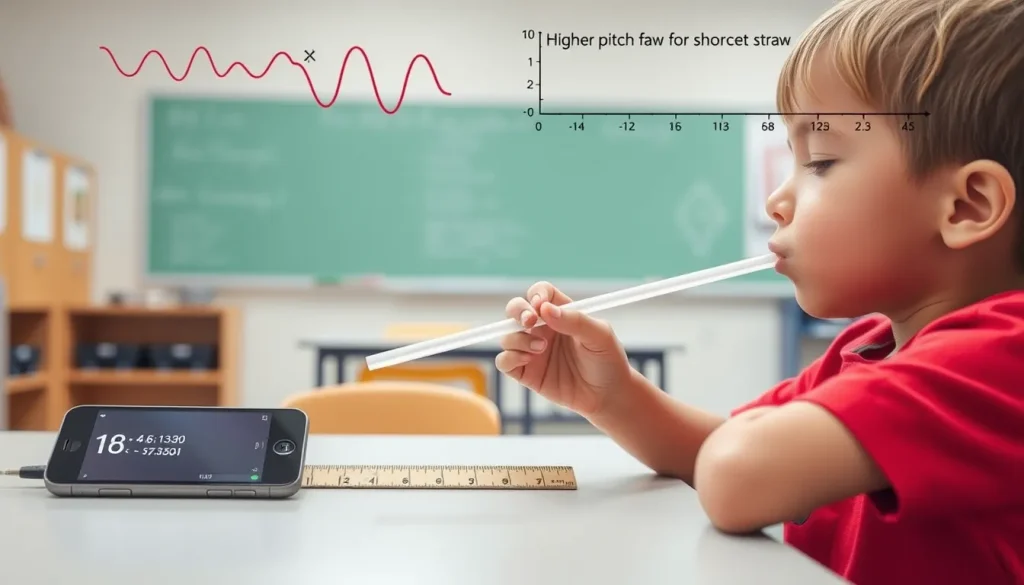
When you blow across the cut end of a flattened soda straw, the air inside vibrates like the string of a guitar. The vibration creates a sound whose pitch (how high or low it sounds) depends mainly on the length of the vibrating air column. This project lets children test the idea: shorter straws produce higher pitches, longer straws produce lower pitches. The activity is safe, inexpensive, and can be completed in a single class period.
Before you begin
- Choose a well‑ventilated space – blowing into straws can be a little noisy.
- Supervise younger children when they use scissors or bite the straw to flatten it.
- Gather a ruler or measuring tape that shows centimeters (or inches) and a smartphone or tablet with a free pitch‑detecting app (e.g., “Spectroid” for Android or “Audio Spectrum Analyzer” for iOS).
Materials
- Plastic drinking straws (standard 6 mm diameter works well). You will need at least 5–6 straws of the same brand.
- Sharp scissors.
- Ruler or metric tape measure.
- Masking tape (optional – to mark measured lengths).
- Smartphone or tablet with a pitch‑detecting app (free download).
- Paper and pencil for recording data.
How the experiment works
The straw acts as a closed‑end air column. When you blow, the reed you create at the flattened end vibrates and forces the air column to vibrate at a natural frequency. For a closed pipe, the fundamental frequency (the lowest note) is given by:
f = v / (4 L)
where f is frequency (Hz), v is the speed of sound in air (≈ 340 m s⁻¹ at room temperature), and L is the length of the air column. Because v is essentially constant, frequency is inversely proportional to length – halve the length and the pitch roughly doubles (goes up an octave). This relationship is demonstrated in the LIGO “Straw Oboe” activity, which uses the same formula to calculate frequency from straw length [3](https://www.ligo.caltech.edu/LA/system/media_files/binaries/342/original/Straw_Oboe_pitch.pdf?1502465859=).
Procedure
- Prepare the reeds. Bite or press the end of each straw between your teeth (or thumb and forefinger) to flatten about 2 cm of the tip. Make the flattened section flexible but not broken.
- Cut the “lips.” Using scissors, cut two small, symmetric slits on either side of the flattened tip so the opening looks like a duck’s beak. This creates a reed that will vibrate when you blow (see Exploratorium description [1](https://www.exploratorium.edu/snacks/straw-oboe)).
- Measure the initial length. Using the ruler, measure the total length of the straw from the tip you will blow into to the opposite end. Record this length in centimeters.
- Mark the length. If you plan to cut the straw to shorter pieces, place a small piece of tape at the measured length so you can see where to cut.
- Play the straw. Hold the reed end just inside your lips, seal around it, and blow gently. Adjust lip pressure until you hear a clear tone.
- Record the pitch. Open the pitch‑detecting app and hold the phone a few centimeters from the vibrating straw. The app will display the dominant frequency in Hertz (Hz). Write the value in your data table.
- Shorten the straw. Using scissors, cut the straw to a new length that is at least 2 cm shorter than the previous piece. Re‑measure, note the new length, and repeat steps 4–6.
- Repeat. Continue making shorter pieces until the straw is too short to produce a clear tone (usually below 5 cm). Aim for at least five different lengths.
What to observe and record
For each straw length, record the following:
- Length (cm)
- Measured frequency (Hz) from the app
- Qualitative note (e.g., “clear high note,” “fuzzy,” “no sound”)
Use the table below as a template. Leave the result cells empty until you conduct the experiment.
Data table
| Trial | Straw length (cm) | Frequency (Hz) | Notes |
|---|---|---|---|
| 1 | |||
| 2 | |||
| 3 | |||
| 4 | |||
| 5 |
Graphing your results
Plot frequency (Hz) on the vertical axis and straw length (cm) on the horizontal axis. The points should form a curve that slopes downward, illustrating the inverse relationship. If you connect the points, the shape will resemble a hyperbola. For a more quantitative view, you can plot 1/Length on the x‑axis; the data should then approximate a straight line, confirming the formula f ∝ 1/L.
The science explained
When you blow into the reed, the reed vibrates and forces the column of air inside the straw to vibrate at its natural resonant frequencies. A closed‑end pipe (one end effectively sealed by the reed) supports standing waves whose wavelength is four times the length of the pipe for the fundamental note. Because the speed of sound (v) is the product of frequency and wavelength (v = f λ), solving for frequency gives f = v / (4L). Hence, as the length L gets shorter, the frequency f gets larger – we hear a higher pitch. The relationship is not perfectly linear because real straws have thickness, bends, and end corrections, but the trend is clear and matches the observations from the LIGO straw‑oboe worksheet [3](https://www.ligo.caltech.edu/LA/system/media_files/binaries/342/original/Straw_Oboe_pitch.pdf?1502465859=).
Variables and controls
- Independent variable: Straw length (cm).
- Dependent variable: Pitch, measured as frequency (Hz).
- Controlled variables: Same brand and diameter of straw, same reed shape, same blowing pressure (try to keep a steady, moderate breath), same ambient temperature (affects speed of sound), and same distance between straw and pitch‑detecting microphone.
Repeated trials
For each length, repeat the blowing and measurement at least three times and record the average frequency. Small variations are normal because breath pressure changes slightly each time. Averaging reduces random error and gives a clearer picture of the underlying relationship.
Troubleshooting
- No sound at all: Check that the reed cuts are symmetrical and not too deep; the reed must be flexible enough to vibrate.
- Very weak or squeaky tone: Your blowing pressure may be too low or too high. Experiment with gentle, steady breath while keeping the lips sealed around the reed.
- App shows wildly varying frequencies: Hold the phone steady and keep the microphone a consistent distance (about 5 cm). Background noise can confuse the app.
- Pitch does not change much when you cut the straw: Make sure you are measuring the total length from the reed tip to the far end; cutting off only a tiny segment will produce a small change.
Cleanup and disposal
Collect all cut straw pieces and discard them in the recycling bin if your community accepts plastic film. Wash scissors and any reusable tools. Store the smartphone app for future investigations.
Next steps
Once the basic length‑pitch relationship is clear, try one of these extensions:
- Change the diameter. Use a thicker or thinner straw while keeping length constant and see how pitch changes.
- Make a simple “straw trombone.” Slide a smaller‑diameter straw inside a larger one and slide it to vary the effective length while playing, as described by the American Physical Society’s straw‑trombone activity [2](https://www.aps.org/learning-resources/students/straw-trombone).
- Calculate the speed of sound. Rearrange the formula to solve for v using your measured frequencies and lengths, then compare to the accepted 340 m s⁻¹ value.
These follow‑up ideas deepen the investigation and connect the simple straw instrument to broader concepts in acoustics and physics.
Related terms
- Pitch
- How high or low a sound is perceived; determined by the frequency of the sound wave.
- Frequency
- The number of vibrations per second of a sound wave, measured in hertz (Hz).
- Reed
- A thin, flexible piece of material that vibrates when air is blown across it, creating sound.
- Air column
- The length of air inside a tube that vibrates to produce sound; its length affects the pitch.
Sources & references
- Exploratorium. “Straw Oboe: Sound & Waves Science Activity.” https://www.exploratorium.edu/snacks/straw-oboe
- American Physical Society. “Straw Trombone.” https://www.aps.org/learning-resources/students/straw-trombone
- LIGO Laboratory. “Straw Oboe – Determine the frequency of a straw.” https://www.ligo.caltech.edu/LA/system/media_files/binaries/342/original/Straw_Oboe_pitch.pdf?1502465859=