Overview
This activity lets families use a smartphone’s microphone as a scientific instrument and a homemade tuning fork as a controllable sound source. By measuring the sound level at different distances, children discover two core ideas:
- Sound intensity is expressed in decibels (dB) and follows a logarithmic scale.
- The inverse‑square law predicts that intensity drops by about 6 dB each time the distance from the source doubles.
The project combines hands‑on construction, data collection, and a short explanation of why the observations make sense.
Before You Begin
- Adults should help download a free sound‑meter app. Good options are “Sound Meter” (Android) or “Decibel X” (iOS). The app must display dB values in real time.[1]
- Choose a quiet room for baseline measurements and a space where the tuning fork can be struck without echo (e.g., a carpeted floor).
- Explain to children that loud sounds can harm hearing; keep the fork’s volume at a comfortable level.
Materials
| Item | Typical quantity | Notes / Substitutes |
|---|---|---|
| Smartphone with internet access | 1 | Any modern Android or iOS device. |
| Free sound‑meter app | 1 | Search “sound meter” or “decibel” in the app store.[1] |
| Metal or hard plastic rod (e.g., a 10‑cm kitchen fork, small screwdriver, or a thin metal strip) | 1 | Length about 10 cm; thickness 2–4 mm. |
| Rubber eraser or small piece of foam | 1 | Used to create the fork’s two prongs. |
| Ruler or tape measure | 1 | For setting distances (30 cm, 60 cm, 120 cm, etc.). |
| Paper and pencil | 1 set | To record measurements. |
| Optional: PhyPhox app (for spectrum analysis) | 1 | Provides a visual frequency plot.[4] |
Step‑by‑Step Procedure
- Build the tuning fork.
- Take the metal rod and gently bend one end upward to form two parallel prongs about 2 cm apart. The prongs should be of equal length; aim for a total fork length of ~8 cm.
- Secure the base with a small piece of tape if needed. The fork will vibrate when struck, producing a clear tone.
- Calibrate the smartphone.
- Open the sound‑meter app and place the phone on a flat surface, microphone pointing upward.
- Record the ambient background level (e.g., a quiet room). Note this value; it will be subtracted from later readings if desired.
- Measure at the first distance.
- Position the tuning fork on a table. Use the ruler to mark a point 30 cm away from the fork’s tip.
- Place the smartphone’s microphone at that point, held steady (a stand or a book can help).
- Strike the fork gently with a rubber eraser. Immediately start the app’s “live” reading and record the maximum dB value shown (e.g., 68 dB).
- Repeat for additional distances.
- Move the phone to 60 cm, then 120 cm, then 240 cm, keeping the fork stationary.
- For each distance, strike the fork the same way and record the peak dB reading.
- Do two trials at each distance to gauge consistency.
- Optional frequency check.
- If you installed PhyPhox, select the “Audio Spectrum” tool and record a short clip of the fork’s tone.
- The app will display the dominant frequency (typically 440–800 Hz for a simple fork). This links the audible pitch to the concept of frequency.
- Record data. Use the table below (or a notebook) to log distance, trial number, and dB reading.
What to Observe or Measure
For each distance you will have two numbers:
- Distance (cm) – measured from the fork tip to the phone microphone.
- Sound level (dB) – the highest value shown after the fork is struck.
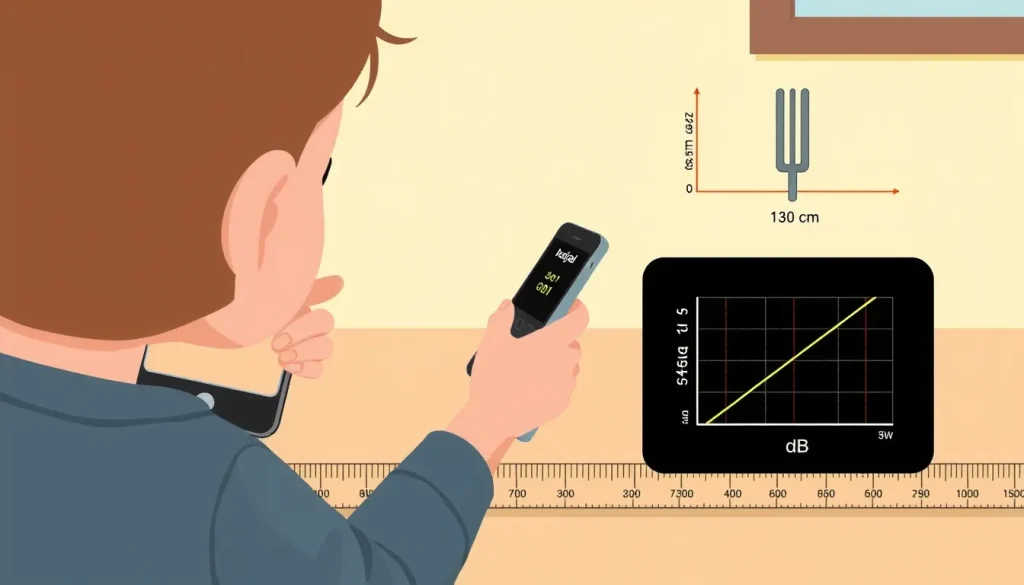
Look for the pattern that the dB value drops roughly 6 dB each time the distance doubles. This is the inverse‑square law in action.

Data Table (blank)
| Distance (cm) | Trial | Peak dB |
|---|---|---|
| 30 | 1 | |
| 30 | 2 | |
| 60 | 1 | |
| 60 | 2 | |
| 120 | 1 | |
| 120 | 2 | |
| 240 | 1 | |
| 240 | 2 |
The Science Explained
Decibels and logarithms. Sound intensity is the power per unit area of a sound wave. Because the human ear can hear a huge range of intensities, scientists use a logarithmic scale called decibels (dB). An increase of 10 dB means the sound intensity is ten times greater, while a 3 dB rise corresponds to a doubling of intensity.
Inverse‑square law. A point source radiates sound equally in all directions. The energy spreads over the surface of an expanding sphere. The surface area of a sphere grows with the square of the radius (A = 4πr²). Consequently, the intensity at distance r is proportional to 1/r². On a dB scale this translates to a drop of about 6 dB each time the distance doubles. The experiment above lets children see that rule with real numbers.[2]
Frequency and pitch. The tuning fork’s vibration frequency determines the pitch we hear. Higher‑frequency forks vibrate faster and produce a higher‑pitched tone. While the dB meter does not measure frequency, the optional PhyPhox spectrum tool can show the dominant frequency, linking the concepts of pitch, vibration, and sound energy.[4]
Troubleshooting
- Reading stays at background level. The fork may not be striking hard enough. Use a firmer eraser or tap the base gently with a fingertip.
- Very noisy readings. Echoes or reflections from hard walls can inflate dB values. Move to a carpeted room or place a blanket behind the fork to absorb reflections.
- App reports “0 dB” or “–∞”. Check that the phone’s microphone is not covered and that the app has permission to use the microphone.
- Large variation between trials. Ensure the strike force is consistent and keep the phone’s orientation the same for each measurement.
Next Steps
Once the basic inverse‑square law is confirmed, families can extend the investigation:
- Try forks of different lengths (different frequencies) and see whether the rate of dB drop changes.
- Measure sound from everyday sources (a speaker, a kitchen blender) and compare their intensity curves.
- Use the data to create a simple line graph (distance on the x‑axis, dB on the y‑axis) and draw a trend line. The slope should be close to –6 dB per doubling of distance.
These extensions deepen understanding of how sound travels and how engineers control noise in real‑world settings.
Related terms
- Decibel (dB)
- A logarithmic unit that expresses the ratio of a sound’s intensity to a reference level; each 10 dB increase represents ten times the intensity.
- Tuning fork
- A metal instrument that vibrates at a fixed frequency when struck, producing a pure musical tone.
- Inverse‑square law
- A physical principle stating that a point source’s intensity decreases proportionally to the square of the distance from the source.
- Frequency
- The number of vibrations per second of a sound wave, measured in hertz (Hz); higher frequency means higher pitch.
Sources & references
- DIY Science – Smartphone Sound Meter, https://www.scienceweek.net.au/wp-content/uploads/2024/08/Smartphone-sound-meter.pdf
- Home‑Made Simple Experiment to Measure Sound Intensity using Smartphones, https://ejournal.radenintan.ac.id/index.php/al-biruni/article/download/8180/pdf
- Science with a Smartphone: Decibel Meter, Scientific American, https://www.scientificamerican.com/article/science-with-a-smartphone-decibel-meter/
- Acoustic experiments (PhyPhox guide), https://www.jyu.fi/sites/default/files/2023-06/Acousticexperiments_Student_English.pdf