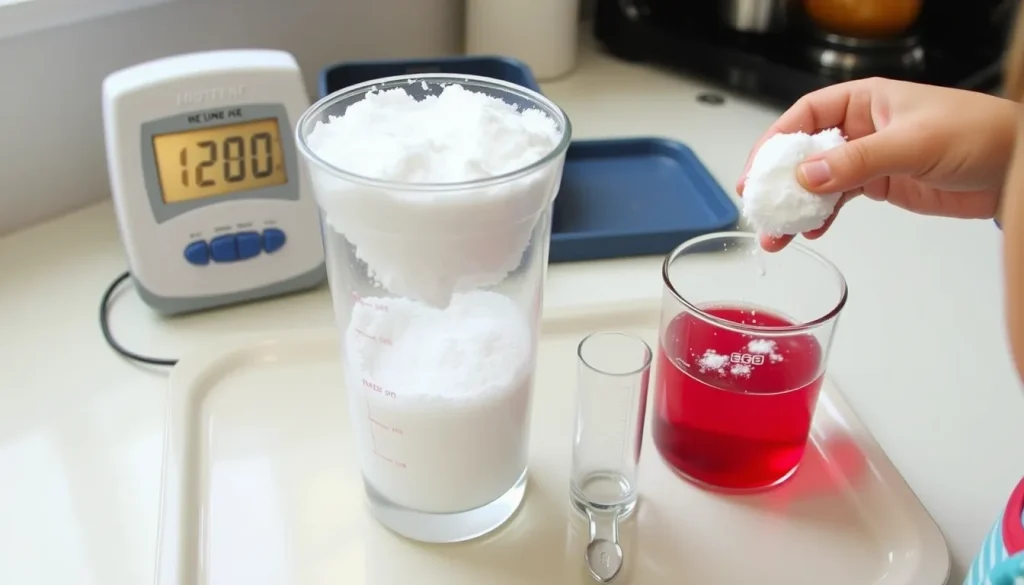
Overview
The reaction between sodium bicarbonate (baking soda) and acetic acid (vinegar) is a favorite classroom demonstration because it is safe, colorful, and uses everyday items. While many people watch the bubbling “volcano,” you can also treat the fizz as data. By measuring how long the reaction takes to finish, you obtain a simple but meaningful reaction‑rate measurement. This guide shows how to set up the experiment, what to record, and how to interpret the results.
Before You Begin
- Adult supervision: The activity uses a small amount of vinegar (an acid) and a kitchen scale if you want precise masses. Supervision is recommended for children under 12.
- Workspace: Use a tray or large bowl to catch overflow. A well‑ventilated kitchen or science lab is ideal because carbon dioxide (CO₂) is released.
- Equipment check: Ensure the stopwatch (or phone timer) works, the thermometer is clean, and all containers are clean and dry.
Materials
| Item | Typical Quantity |
|---|---|
| White distilled vinegar (5 % acetic acid) | 200 mL per trial |
| Baking soda (sodium bicarbonate) | 5 g per trial (≈1 tsp) |
| Digital kitchen scale (optional but recommended) | – |
| Thermometer (°C or °F) | – |
| Stopwatch or phone timer | – |
| Clear plastic cup or beaker (250 mL) | 1 per trial |
| Stirring rod or spoon | 1 |
| Tray or large bowl (to catch overflow) | 1 |
| Paper towel (for cleanup) | 1 |
Substitutions: Any clear liquid acid (e.g., lemon juice) can replace vinegar, but the concentration must be known for quantitative comparison. Any fine powder of sodium bicarbonate works; avoid pre‑mixed “baking powder” because it contains additional acids.
Step‑by‑Step Procedure
- Label three cups “Cold,” “Room,” and “Warm.” Fill each with 200 mL of vinegar. Record the temperature of each cup with the thermometer.
- Weigh 5 g of baking soda on the scale (or measure one level teaspoon if a scale is unavailable). Set the measured powder aside for each trial.
- Place the tray on the work surface. When ready, start the stopwatch and immediately add the baking soda to the vinegar in the first cup. Quickly stir with the rod to ensure thorough mixing.
- Observe the mixture until the vigorous bubbling visibly stops and the solution appears nearly color‑neutral (the pink of vinegar will fade). Stop the timer at that moment and record the elapsed time in seconds.
- Repeat steps 3–4 for the “Room” and “Warm” cups, using fresh 5 g portions each time.
- Clean the cup between trials by rinsing with water and drying with a paper towel.
- Perform at least three repeats for each temperature to assess variability.
Tip: To make the end‑point clearer, add a few drops of red cabbage indicator to each vinegar cup before the reaction. The color will shift from pink (acidic) to violet (near neutral) as CO₂ neutralizes the acid, providing a visual cue for when to stop the timer. This method was used in a classroom study of temperature effects on the same reaction【4†URL】.
What to Observe or Measure
- Reaction time (seconds): The primary quantitative measure. Record the exact time from the moment the powder contacts the liquid until bubbling ceases.
- Temperature (°C or °F): Note the starting temperature of each vinegar sample. This is the independent variable in the example below.
- Visual cues: Note the color change of the cabbage indicator (if used) and any overflow.
Variables and Controls
| Variable Type | Details |
|---|---|
| Independent variable | Temperature of the vinegar (cold, room, warm) |
| Dependent variable | Time required for the reaction to finish (seconds) |
| Controlled variables | Amount of baking soda (5 g), volume of vinegar (200 mL), container size, stirring method, and observation criteria (color change) |
If you wish to explore a different factor—such as amount of baking soda, surface area (powder vs. granulated), or the presence of a catalyst—keep all other variables constant in the same way.

Repeated Trials and Why They Matter
Each temperature condition should be repeated at least three times. Repeating reduces the impact of random errors (e.g., slight differences in mixing speed) and lets you calculate an average and a standard deviation. Those statistics give a more reliable picture of how temperature influences the rate.
Data Table (Blank)
| Trial # | Temperature (°C) | Time (s) |
|---|---|---|
| 1 | ||
| 2 | ||
| 3 | ||
| 4 | ||
| 5 | ||
| 6 |
Fill in one row for each trial. After completing the repeats, calculate the mean time for each temperature.
Graphing Your Results
A simple scatter plot or bar chart makes the temperature‑rate relationship clear. Place temperature on the horizontal axis and average reaction time on the vertical axis. If you have error bars (standard deviation), include them to show experimental spread. Many free spreadsheet programs (Google Sheets, Excel) can generate the graph automatically.
The Science Explained
The reaction is an acid‑base neutralization:
NaHCO₃ (s) + CH₃COOH (aq) → CO₂ (g) + H₂O (l) + CH₃COONa (aq)
Two observable phenomena occur:
- Carbon dioxide formation: The gas creates bubbles that make the mixture fizz.
- Temperature change: The reaction is slightly endothermic; the mixture may feel cooler as it proceeds.
Reaction rate depends on how often reacting molecules collide with enough energy to overcome the activation energy barrier. Raising the temperature gives molecules more kinetic energy, increasing collision frequency and thus speeding the reaction—exactly what you will see when the warm vinegar finishes faster than the cold sample【2†URL】【4†URL】.
Other factors that influence the rate (and can be explored in follow‑up experiments) include:
- Concentration: More acetic acid molecules per unit volume raise the chance of collision.
- Surface area: Finely powdered baking soda presents more surface for the vinegar to attack, speeding gas evolution【3†URL】.
- Catalysts: In the lab, a small amount of a solid acid or base could lower the activation energy, but for a kitchen experiment the reaction proceeds without added catalyst.
Troubleshooting Common Issues
| Observation | Possible Cause | Suggested Fix |
|---|---|---|
| No visible bubbling | Insufficient acid or base; vinegar too dilute | Use standard 5 % vinegar and accurate 5 g of baking soda |
| Reaction continues for a very long time | Large excess of baking soda relative to acid | Reduce baking‑soda amount or increase vinegar volume |
| Overflow spills onto work surface | Container too small for gas volume | Use a larger beaker or perform the reaction in a tray |
| Timing varies wildly between repeats | Inconsistent stirring or delayed start of stopwatch | Practice a consistent “add‑and‑start” motion; use a pre‑set timer that starts on button press |
Safety and Cleanup
- The reactants are low‑hazard household items, but the solution can be mildly acidic. Wash hands after handling.
- Ventilate the area if you perform many trials in a small room; CO₂ is non‑toxic at these levels but can displace oxygen in poorly ventilated spaces.
- Dispose of the spent solution by pouring it down the sink with plenty of water. Clean the cup with dish soap.
Extending the Investigation
Once the basic temperature test is mastered, try one of the following extensions:
- Vary the amount of baking soda: Keep vinegar volume constant and see how the reaction time changes.
- Change surface area: Compare fine powder, granulated crystals, and a pre‑compressed “tablet” form of baking soda.
- Introduce a catalyst: A pinch of citric acid or a drop of liquid soap can alter bubble formation and may affect measured time.
- Measure gas volume: Capture the CO₂ in an inverted graduated cylinder and compare volume to reaction time.
Each extension introduces a new independent variable while keeping the others constant, turning the activity into a full experiment suitable for a science fair.
Conclusion
Measuring the speed of the baking‑soda‑vinegar reaction with a stopwatch transforms a fun kitchen fizz into a quantitative exploration of chemical kinetics. By controlling variables, repeating trials, and graphing the data, children develop skills in observation, data handling, and scientific reasoning—all with materials found in most homes.
FAQ
Is the experiment safe for young children?
Yes. Vinegar and baking soda are low‑hazard household items. Children should wear gloves or wash hands after handling, and an adult should supervise the mixing and use of the thermometer.
How many trials are enough?
Three repeats per condition give a basic sense of variability and allow you to calculate an average and standard deviation. More trials improve confidence but also require more time.
Can I use lemon juice instead of vinegar?
You can, but lemon juice’s acid concentration varies. To compare results accurately, measure its exact acidity (pH or % citric acid) and keep it consistent across trials.
What if the reaction never seems to stop?
Check that you have not added too much baking soda relative to vinegar. Excess base will keep producing CO₂ slowly. Reduce the amount of baking soda or increase the vinegar volume.
Do I need a digital scale?
A scale gives the most precise 5 g measurement. If you don’t have one, a level teaspoon of baking soda is a reasonable approximation for elementary investigations.
Related terms
- Reaction rate
- The speed at which reactants are converted into products, usually expressed as change in concentration per unit time.
- Acid‑base reaction
- A chemical process where an acid donates a proton to a base, producing water and a salt; in this case vinegar (acid) reacts with baking soda (base).
- Activation energy
- The minimum amount of energy that reacting molecules must have for a collision to result in a chemical change.
- Surface area
- The total area exposed to another substance; finer particles have more surface area, allowing faster reactions.
- Catalyst
- A substance that speeds up a reaction without being consumed, by lowering the activation energy.
Sources & references
- Ask an Expert: How Can I find the rate on Baking soda and vinegar reacting? https://www.sciencebuddies.org/science-fair-projects/ask-an-expert/viewtopic.php?t=3052
- Chemical Kinetics - Measuring Reaction Rates with Temperature | Science Fair Projects https://sciencefair-projects.org/projects/chemical-kinetics-reaction-rates-temperature
- Rates of Reaction Laboratory Experiment – Catherine Haslag https://haslag.us/resources-for-riverland-students/introchemlabmanual/rates-of-reaction/
- Reaction Kinetics | Science for All Outreach Program https://sfa.cems.umn.edu/reaction-kinetics-2