Overview
Solar ovens are a hands‑on way for children ages 6‑14 to see sunlight turned into heat. By using a cardboard pizza box, aluminum foil, plastic wrap, and a few everyday items, you can construct an oven that is capable of raising its internal temperature by several degrees in just a few minutes. The activity doubles as an engineering challenge (designing a functional oven) and a simple experiment (measuring how fast the temperature rises) – perfect for classroom labs, after‑school clubs, or family science nights.
Before You Begin
- Weather: Choose a sunny day with clear skies. Direct sunlight is essential for a measurable temperature rise.
- Location: Set up the oven on a flat, non‑reflective surface that receives full sun for the duration of the test (e.g., a concrete patio or a sturdy table).
- Adult supervision: Required for cutting cardboard, handling scissors, and using a thermometer.
- Safety note: The oven can become hot enough to burn skin. Use oven mitts or a cloth when handling the box after testing.
Materials
| Item | Quantity | Notes / Substitutions |
|---|---|---|
| Pizza box (standard size, ~12″×12″×2″) | 1 | Any cardboard pizza delivery box works. |
| Aluminum foil | 1 sheet (≈12″×12″) | Heavy‑weight foil works best for reflecting sunlight. |
| Clear plastic wrap (shrink film or kitchen wrap) | 1 piece (≈12″×12″) | Must be airtight; avoid low‑density wrap that tears easily. |
| Black construction paper | 1 sheet (≈12″×12″) | Black surface absorbs heat; a piece of dark cardboard can substitute. |
| Newspaper (for insulation) | 3–4 sheets | Crumbled and folded around the oven walls. |
| Scissors or craft knife | 1 | Adult use only. |
| Clear packing tape | 1 roll | Standard office tape works. |
| Ruler | 1 | For measuring the flap opening. |
| Thermometer (digital or mercury) | 1 | Preferably with a probe that fits inside the box. |
| Sticky notes or masking tape (optional) | 1 pack | To label measurements. |
All items are commonly found at home or in a classroom supply closet. The NASA lesson plan notes that the only design constraints are the box size and a required temperature increase of 5 °C in 5 minutes【1】.
Building the Oven (Step‑by‑Step)
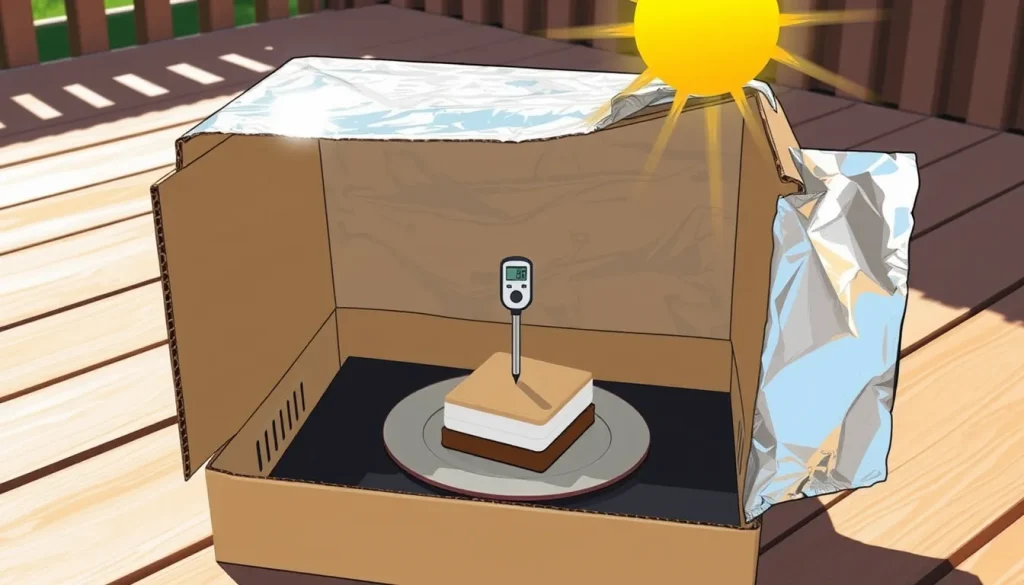
- Prepare the lid. Using scissors, cut a 1‑inch wide flap along three sides of the pizza box lid, leaving the hinge on the back side intact. Fold the flap open so it creates a shallow “window.”
- Line the flap with foil. Cover the inner side of the flap (the side that will face the sun) with aluminum foil, shiny side out. Secure with tape, ensuring a smooth, wrinkle‑free surface.
- Insert the black absorber. Cut the black construction paper to fit the bottom of the box. Tape it securely; this will be the surface that absorbs solar energy.
- Insulate the walls. Crumple newspaper and line the interior walls of the box (except the bottom). This air‑filled insulation reduces heat loss.
- Seal the top. Stretch a piece of clear plastic wrap over the opening, taping it on all four sides to create an airtight window. The plastic acts as a greenhouse, trapping infrared radiation.
- Position the reflector. Fold the foil‑covered flap upward at an angle (about 45°) so it reflects sunlight into the box. Adjust the angle later during testing for maximum heat.
- Place the thermometer. Position the probe in the center of the black paper, not touching the foil or plastic. Record the starting ambient temperature.
- Start the test. Place the oven in direct sun, with the foil flap facing the sun. Begin timing and record temperature every minute for at least 10 minutes.
These steps follow the widely used “pizza box oven” design described by Vernier and the U.S. Department of Energy【3】【4】.
What to Observe and Measure
- Temperature rise: Record the internal temperature (°C) at 1‑minute intervals. Note the time when the temperature first exceeds the ambient temperature by 5 °C.
- Visual cues: Look for fogging on the plastic (indicates humidity and heat) and any melting of test food (e.g., chocolate).
- Sun angle: Sketch the sun’s position relative to the oven at the start of the test; this helps explain variations later.
Variables, Controls, and Repeated Trials
Independent variable: The factor you change between trials – for example, the angle of the foil reflector, the amount of newspaper insulation, or the color of the absorber sheet.

Dependent variable: The internal temperature rise (°C) measured over time.
Controlled variables: Box size, thermometer type, outdoor temperature, time of day, and duration of sunlight exposure. Keeping these constant allows a fair comparison of design changes.
Run at least three trials with the same configuration to assess repeatability. Record each trial’s temperature‑time series in the data table provided below.
Data Table
| Trial # | Minute 0 (°C) | Minute 1 | Minute 2 | Minute 3 | Minute 4 | Minute 5 | Minute 6 | Minute 7 | Minute 8 | Minute 9 | Minute 10 |
|---|---|---|---|---|---|---|---|---|---|---|---|
| 1 | |||||||||||
| 2 | |||||||||||
| 3 |
Graphing the Results
Plot temperature (y‑axis) against time (x‑axis) for each trial. A line graph makes it easy to see the rate of heating and to compare different design changes. Look for the point where the line crosses the “ambient +5 °C” threshold – that is the success metric from the NASA challenge.
The Science Behind a Solar Oven
Solar ovens rely on three basic physical processes:
- Reflection: Aluminum foil redirects incoming solar radiation toward the interior.
- Absorption: The black paper absorbs a wide spectrum of wavelengths, converting light energy into heat.
- Greenhouse effect: The clear plastic trap infrared radiation emitted by the hot absorber, preventing it from escaping quickly.
Because the sun’s surface temperature is about 5,500 °C, even a small fraction of its energy can raise the temperature inside a well‑insulated box dramatically. However, the amount of heat captured depends on the oven’s orientation, the reflectivity of the foil, and how well the box is insulated from the surrounding air.
Design Constraints and Success Criteria
- Constraint: The oven must be built from a single pizza box and fit on a tabletop.
- Success criterion (NASA): Increase the internal temperature by at least 5 °C within 5 minutes of exposure to direct sun.
- Additional criteria for families: Ability to melt a marshmallow and chocolate (classic s’more) and safe handling after the test.
Troubleshooting Common Issues
| Problem | Possible Cause | Check / Fix |
|---|---|---|
| Temperature rises very slowly | Foil is wrinkled or angled incorrectly | Smooth the foil and adjust angle to directly reflect sun into the box. |
| Plastic fogs but temperature stays low | Insufficient insulation; heat is escaping through the walls | Add extra crumpled newspaper or cardboard around the sides. |
| Thermometer reads the same as ambient | Probe not placed on black absorber or touching plastic | Re‑position probe onto the black paper, away from the plastic. |
| Box overheats and plastic melts | Too much direct sunlight on plastic; poor ventilation | Reduce exposure time or use a thicker, heat‑resistant wrap. |
Worked Example (Illustrative)
Suppose you set the foil flap at a 45° angle, use three sheets of newspaper for insulation, and record the following temperatures on a sunny 25 °C day:
- Minute 0: 25 °C (ambient)
- Minute 1: 28 °C
- Minute 2: 31 °C
- Minute 3: 34 °C
- Minute 4: 37 °C
- Minute 5: 40 °C
In this example the oven exceeds the +5 °C goal after just 3 minutes, satisfying the NASA success criterion. You could then experiment by adding a second layer of foil or increasing the insulation to see whether the temperature reaches 45 °C in the same time.
Next Steps and Extensions
- Design challenge: Redesign the oven to melt a chocolate bar in under 5 minutes. Record the new temperature curve and compare.
- Science‑fair angle: Formulate a testable question such as, “How does the angle of the reflector affect the rate of temperature rise?” Use the variables‑control framework to structure the investigation (see Carleton’s activity guide)【2】.
- Connect to climate topics: Discuss how solar ovens illustrate renewable energy and why sunlight is a clean power source, linking to Earth and climate science curricula.
With a simple pizza box and a few minutes of sunshine, families can explore optics, heat transfer, and engineering design—all while making a tasty snack.
Related terms
- Solar energy
- Radiant light and heat from the Sun that can be captured and converted into usable power.
- Albedo
- The reflectivity of a surface; bright, shiny surfaces like aluminum foil have high albedo and reflect most incoming sunlight.
- Conduction
- Transfer of heat through direct contact between materials, such as from the hot absorber to the thermometer probe.
Sources & references
- NASA, "Cooking with the Sun: Build a Solar Oven Design Challenge," https://www.nasa.gov/wp-content/uploads/2024/02/nasa-lp-solar-oven.pdf?emrc=66f923
- Carleton SERC, "Researching, constructing, and testing (student made) Solar Ovens," https://serc.carleton.edu/sp/mnstep/activities/26389.html
- Vernier, "Solar Pizza Box Oven," https://www.vernier.com/vernier-ideas/solar-pizza-box-oven/
- U.S. Department of Energy, "Build a Pizza Box Solar Oven," https://www1.eere.energy.gov/education/pdfs/lesson298.pdf