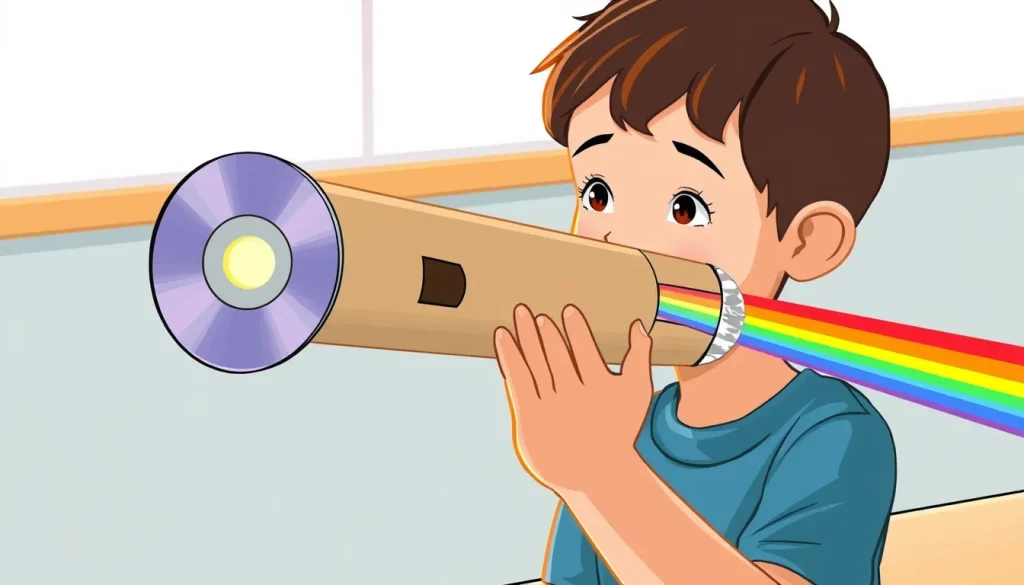
White light—whether it comes from the Sun, a lamp, or a computer screen—appears colorless to our eyes because many colors are blended together. A spectroscope separates those colors so the hidden rainbow becomes visible. By using a discarded compact disc (CD) as a diffraction grating and a cardboard tube as a light‑tight housing, families can build a functional spectroscope with items that are usually at hand.
Before You Begin
- Adult supervision: Cutting a cardboard tube and handling a craft knife or X‑ACTO blade requires adult help, especially for younger children (under 10).
- Workspace: Work on a flat surface covered with newspaper or a disposable tablecloth to catch any stray shards.
- Safety: Wear safety glasses if possible, and keep the cutting tool pointed away from hands.
- Time estimate: About 30 minutes for construction, plus a few minutes for each observation.
Materials
- One standard CD (any data CD works; a DVD can be used but the groove spacing is different and may give a fainter spectrum).
- Cardboard tube at least 12 inches (30 cm) long and 3–4 inches (7.5–10 cm) in diameter. A mailing tube, paper‑towel roll, or a clean toilet‑paper core works.
- Two pieces of flat cardboard or the plastic caps that came with the tube to seal the ends.
- Razor‑blade or X‑ACTO knife.
- Scissors.
- Tape (paper or masking tape works best).
- Optional: aluminum foil for a simple eye‑hole cover (see source [2]).
Step‑by‑Step Construction
- Prepare the CD surface. Using a scissors or a fingernail, gently scratch a line about halfway across the shiny side of the CD to break through the reflective coating. Then apply a piece of tape over the scratch and peel it away; repeat until roughly one‑fifth of the silver paint is removed, creating a clear window where the diffraction grating is exposed. This method follows the GPB guide [2].
- Cut a viewing window. From the cleared area, cut a small square (about 1 cm × 1 cm) that will later be placed over the end of the tube. The square should be smaller than the tube’s opening.
- Make the slit for incoming light. On the opposite end of the tube, cut a narrow slit about 2–3 mm wide and 1 cm long at a 45° angle. The angle helps direct light toward the CD without reflecting directly back to the eye. This technique is described by Optics for Kids [3].
- Insert the CD. Slide the CD into the tube so that the cleared square faces the slit. The shiny side (with the grating) should face outward, toward the eye, while the clear window faces the slit. Tape the CD in place so it does not shift.
- Seal the ends. Cover the far end of the tube (the side opposite the slit) with a piece of cardboard or the plastic cap, securing it with tape. This prevents stray light from entering and improves contrast.
- Make the eye‑hole. Cut a small circular hole (about 5 mm diameter) in a piece of aluminum foil, then tape it over the end of the tube where the CD is visible. The foil hole acts as a simple aperture that lets the diffracted light reach the eye while blocking excess glare. This step is optional but improves image clarity [2].
- Test the instrument. Point the slit at a bright, broad‑spectrum source such as a sunny sky, a fluorescent ceiling light, or a white LED. Look through the eye‑hole; a rainbow‑like spread of colors should appear.
What to Observe
- Color bands: Notice distinct bands of red, orange, yellow, green, blue, indigo, and violet. The order follows the familiar rainbow pattern because shorter wavelengths (violet) are diffracted at larger angles.
- Brightness differences: Some light sources (e.g., fluorescent tubes) show extra bright lines corresponding to the gases inside the lamp.
- Effect of source color: Point the spectroscope at a red shirt, a blue book cover, or a green LED. The dominant color band will be stronger, revealing the primary wavelength emitted by the object.
Record observations in a simple table: light source, dominant color, any extra lines, and a sketch of the spectrum.
The Science Explained
A CD is covered with microscopic grooves spaced about 1.6 µm apart. These grooves act as a diffraction grating—a surface that splits incoming light into many beams that interfere with each other. The condition for constructive interference is given by the grating equation:
n·λ = d·sinθ
where n is the diffraction order (usually 1 for a simple spectroscope), λ is the wavelength of light, d is the spacing between grooves, and <θ is the angle at which that wavelength emerges. Because each wavelength satisfies the equation at a different angle, the colors spread out into a line‑like spectrum.

The cardboard tube simply blocks unwanted light, ensuring that only the light passing through the narrow slit reaches the grating. The aluminum eye‑hole acts as a second aperture, improving contrast by limiting stray reflections.
While the CD spectroscope can show the relative order of colors, it does not provide precise wavelength measurements. For quantitative work, a calibrated diffraction grating with known groove density and a measured distance to a screen would be required (see the ETH Zurich DIY spectrometer guide for a more accurate setup [4]).
Troubleshooting
| Problem | Possible Cause | Solution |
|---|---|---|
| No colors visible | Slit too wide or light source too dim | Make the slit narrower (≈2 mm) and use a brighter source such as sunlight. |
| Rainbow appears faint or blurry | Excess stray light entering the tube | Seal both ends tightly with cardboard and ensure the eye‑hole aperture is small. |
| Only a single color seen | Grating area not properly cleared | Remove more of the reflective coating from the CD (aim for ~20 % cleared) and verify the clear window is positioned correctly. |
| Colors are reversed (violet on left, red on right) compared to expectation | CD inserted upside‑down | Flip the CD so the grating faces the eye‑hole; the order of colors will swap. |
Extensions and Further Exploration
- Measure approximate wavelengths. Place a ruler on a wall behind the spectroscope, measure the distance from the central (undiffracted) line to each color band, and use the known groove spacing of a CD (≈1.6 µm) with the grating equation to estimate wavelengths.
- Compare light sources. Systematically test incandescent bulbs, LED flashlights, smartphone screens, and natural sunlight. Record which spectral lines are strongest.
- Build a calibration chart. Use a known laser pointer (e.g., a red 650 nm laser) to locate its diffraction spot on the ruler. This provides a reference point for converting other color positions to wavelengths.
- Try a DVD or Blu‑ray disc. DVDs have a finer groove spacing, producing a more dispersed spectrum; however, the pattern may be dimmer. Experiment to see the difference.
Cleanup and Storage
- Store the spectroscope in a dry place; the CD is fragile and can scratch easily.
- Recycle any leftover cardboard or foil.
- If you used a disposable razor blade, dispose of it in a sharps container or wrap it securely before trashing.
With a few minutes of preparation, families can turn a common CD into a window on the invisible world of light wavelengths, fostering curiosity and a hands‑on grasp of optics.
FAQ
Can I use a DVD or Blu‑ray disc instead of a CD?
Yes, a DVD or Blu‑ray can serve as the diffraction grating, but the groove spacing is different. DVDs often produce a slightly more spread‑out spectrum, while Blu‑ray discs may give a fainter pattern. If you try one, you may need to adjust the slit width or use a brighter light source.
Why do I need to remove part of the CD’s reflective coating?
The reflective coating blocks the light from reaching the microscopic grooves that act as the diffraction grating. Removing a small area (about 20 % of the surface) exposes the grating so light can be diffracted and the spectrum becomes visible.
Is this spectroscope accurate enough to measure exact wavelengths?
The CD spectroscope is excellent for qualitative observations—seeing the order of colors and comparing sources—but it is not calibrated for precise wavelength measurement. For quantitative work, a calibrated grating with known groove density and a measured distance to a screen is needed (see the ETH Zurich guide).
Related terms
- Diffraction
- The bending and spreading of waves when they encounter an obstacle or opening comparable in size to their wavelength.
- Spectrum
- The range of colors (or wavelengths) that make up light; a spectrum shows how white light separates into its component colors.
- Diffraction grating
- A surface with many closely spaced parallel lines that splits light into several beams traveling in different directions.
- Wavelength
- The distance between successive peaks of a wave; in visible light it determines the perceived color.
Sources & references
- Exploratorium CD Spectroscope activity – https://www.exploratorium.edu/snacks/cd-spectroscope
- GPB Creating a Spectroscope PDF – https://www.gpb.org/sites/default/files/2021-06/creating_a_spectroscope.pdf
- Optics for Kids Homemade Spectroscope – https://www.optics4kids.org/activities/10-and-up/homemade-spectroscope
- ETH Zurich DIY Spectrometer guide – https://ap.phys.ethz.ch/RemoteExperiments/DIYSpectrometer_en.pdf