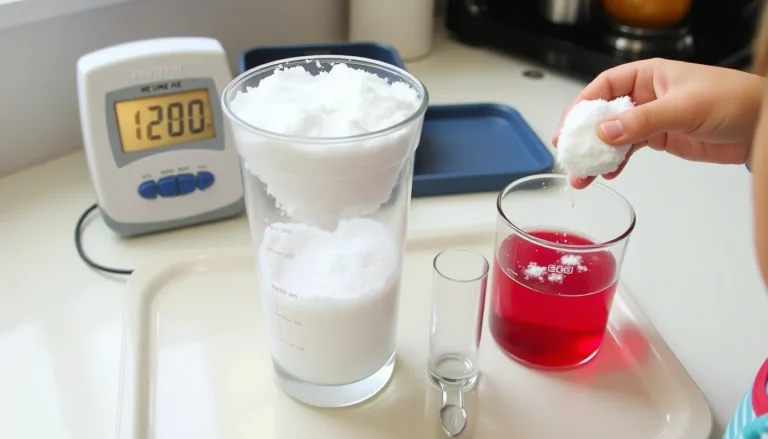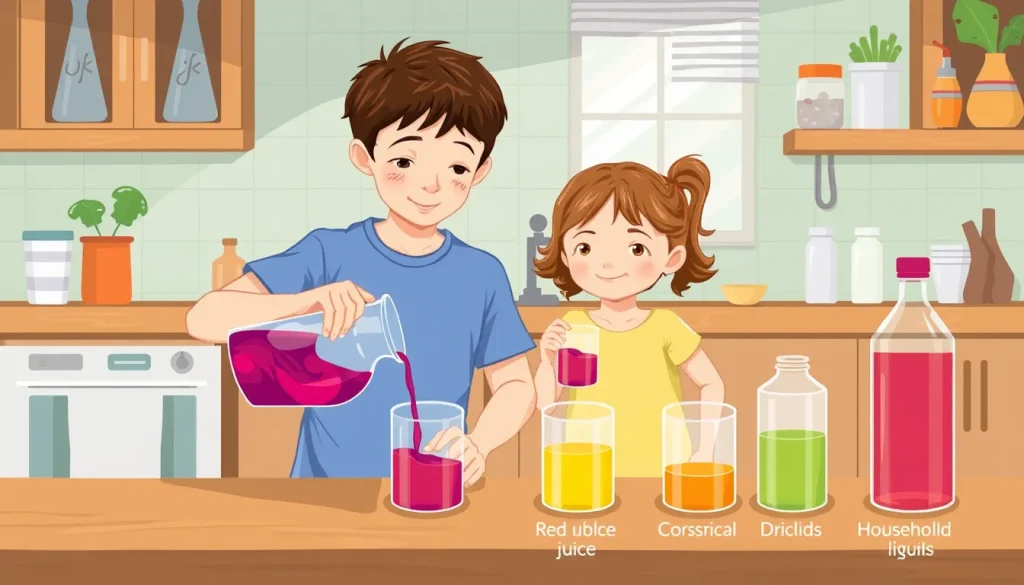
Red cabbage contains natural pigments called anthocyanins that change colour depending on the acidity or basicity of a solution. By extracting these pigments you can create a safe, inexpensive pH indicator that lets children classify household liquids as acidic, neutral, or alkaline. This guide walks parents, teachers, and homeschoolers through every step—from preparing the indicator to recording observations and understanding the chemistry behind the colour changes.
Before you begin
- Adult supervision: Cutting cabbage and handling hot water require a responsible adult.
- Workspace: Use a kitchen counter or table covered with a disposable tablecloth. Keep the area well‑ventilated.
- Safety gear: Wear safety glasses or goggles, and consider gloves if your child’s skin is sensitive. Do not taste any of the solutions.
Materials
- 1 small red cabbage (about ½ lb or 250 g)
- Knife and cutting board (adult use)
- Blender or food processor
- Large pot or kettle for boiling water (≈2 L)
- Strainer or cheesecloth
- Clear glasses or plastic cups (at least 4)
- Measuring cup or graduated cylinder
- Household test liquids (examples: white vinegar, lemon juice, baking‑soda solution, tap water, milk, fruit juice)
- Optional: dropper or cotton swab for applying indicator
All items are common kitchen supplies; no special chemicals are required. If a blender is unavailable, a mortar and pestle can be used to mash the cabbage, though extraction will be slower.
Step‑by‑step procedure
- Prepare the cabbage extract (adapted from ACS and ANU instructions).
- Remove the outer leaves and chop the cabbage into roughly 1‑cm pieces.
- Place the pieces in the blender, add enough cold water to cover them, and blend until the mixture is a fine puree.
- Transfer the puree to a pot, add an additional 1 L of water, and bring to a gentle boil (≈5 minutes). The liquid will turn deep purple.
- Remove from heat and let it cool for a few minutes.
- Strain the mixture through a fine sieve or cheesecloth into a clean container. The resulting liquid is your pH indicator solution.
- Label your test cups. Write the name of each household liquid on a piece of tape or a sticky note and attach it to a separate cup.
- Prepare test solutions.
- For an acid: mix 1 tsp lemon juice with 100 mL water.
- For a base: dissolve ½ tsp baking soda in 100 mL water.
- For neutral water: use tap water as‑is.
- Optional additional tests: milk, fruit juice, soda, salt water, etc.
- Add indicator. Using a dropper or a cotton swab, add 2–3 mL of the cabbage indicator to each cup. Observe the colour change.
- Record observations in the data table below (see “What to observe or measure”).
What to observe or measure
The colour of the indicator gives a visual estimate of pH. Use the following reference chart (adapted from common anthocyanin colour‑pH relationships) to assign an approximate pH range:
| Observed colour | Approximate pH range |
|---|---|
| Red‑pink | pH ≈ 1–3 (strong acid) |
| Orange‑yellow | pH ≈ 4–5 (mild acid) |
| Green‑yellow | pH ≈ 6–7 (near neutral) |
| Green‑blue | pH ≈ 8–9 (mild base) |
| Purple‑blue | pH ≈ 10–12 (strong base) |
| Dark violet | pH ≈ 13–14 (very strong base) |
Record the colour and the corresponding pH estimate in the table below.

| Test liquid | Colour observed | Estimated pH | Notes |
|---|---|---|---|
| Vinegar | |||
| Lemon juice | |||
| Baking‑soda solution | |||
| Tap water | |||
| Milk | |||
| Fruit juice |
The science explained
Anthocyanins are flavonoid pigments that contain several ionizable groups. In acidic solutions the molecule gains a proton (H⁺), shifting its electronic structure so it absorbs light in the green‑yellow region, making the solution appear red‑pink. As the pH rises, the molecule loses protons, changing the conjugated system and causing it to absorb different wavelengths, which we perceive as orange, green, blue, or violet. This reversible colour change is why red cabbage works as a “universal” indicator, covering the full pH scale from about 1 to 14 [1][2][3].
Because the indicator is a mixture of several anthocyanin compounds, the colour transitions are gradual rather than sharp. That is why the colour chart gives ranges rather than single pH values. The method is safe: the pigments are edible, and the solutions used are household items, but they should still be treated as chemicals and not consumed.
Troubleshooting
- Indicator stays colourless: The extraction may have been insufficient. Ensure the cabbage pieces are fully submerged in boiling water and that the mixture is boiled for at least 5 minutes.
- Very dark colour makes it hard to distinguish shades: Dilute the indicator with a small amount of water (1 part water to 4 parts indicator) and retest.
- Unexpected colour (e.g., purple for vinegar): Check that the test solution is truly acidic. Some “vinegar” sold as cleaning agents contains added bases that can neutralise the acid.
- Residue in the indicator: Filter the liquid a second time through a finer cloth or coffee filter to remove cabbage fragments that could scatter light.
Extension ideas
- Use a smartphone colour‑picker app to record the exact RGB values of each test; compare the numeric data to the colour‑pH chart.
- Prepare a series of buffer solutions with known pH (e.g., from a chemistry set) and create a more precise calibration curve.
- Investigate how temperature affects the colour by testing the indicator at room temperature versus chilled water.
Cleanup and disposal
The cabbage extract is biodegradable. Pour any leftover indicator down the sink with plenty of water. Wash all utensils with warm, soapy water. Dispose of solid cabbage waste in compost or the trash.
Next steps
Now that you have a functional pH indicator, you can explore real‑world applications such as testing soil extracts for garden projects, checking the acidity of rainwater, or comparing the pH of different brands of soda. Each new test reinforces the idea that chemistry is all around us.
Related terms
- pH
- A numerical scale (0–14) that measures how acidic or basic a solution is.
- Acid
- A substance that donates hydrogen ions (H⁺) in water, giving a pH below 7.
- Base
- A substance that accepts hydrogen ions or releases hydroxide ions (OH⁻), giving a pH above 7.
- Anthocyanin
- A plant pigment that changes colour with pH, found in red cabbage, berries, and other purple foods.
- Indicator
- A chemical that changes colour at specific pH ranges, allowing visual detection of acidity or alkalinity.
Sources & references
- American Chemical Society. Red Cabbage Indicator – At‑Home activity. https://www.acs.org/content/dam/acsorg/education/outreach/activities/red-cabbage-indicator/red-cabbage-indicator-home.pdf
- Australian National University. DIY Red Cabbage pH Test. https://science.anu.edu.au/engagement/science-lab-experiments-home-school/diy-red-cabbage-ph-test
- Royal Horticultural Society. Red cabbage indicator. https://www.rhs.org.uk/education-learning/school-gardening/resources/curriculum-linked/red-cabbage-indicator
- Pacific Science Center. Purple Produce pH Indicator (6‑8). https://pacificsciencecenter.org/wp-content/uploads/2022/07/cah-purple-ph-indicator-6-8.pdf