Overview
This experiment lets children discover why a breeze makes puddles disappear faster. By measuring how long a measured amount of water takes to evaporate under different airflow speeds, learners see the direct link between moving air and evaporation rate. The activity uses only water, paper containers, a fan or open window, and a stopwatch – all items that are easy to find at home.
Before You Begin
- Choose a well‑ventilated room where you can place a fan safely, or locate a window that can be opened to create a natural draft.
- Make sure the work surface is level and protected with a kitchen towel or newspaper.
- Adults should supervise the use of electrical fans and handle any sharp objects (e.g., scissors).
- Plan for at least 30 minutes of observation time per airflow condition.
Materials
- Plain water (tap water is fine) – about 200 mL total.
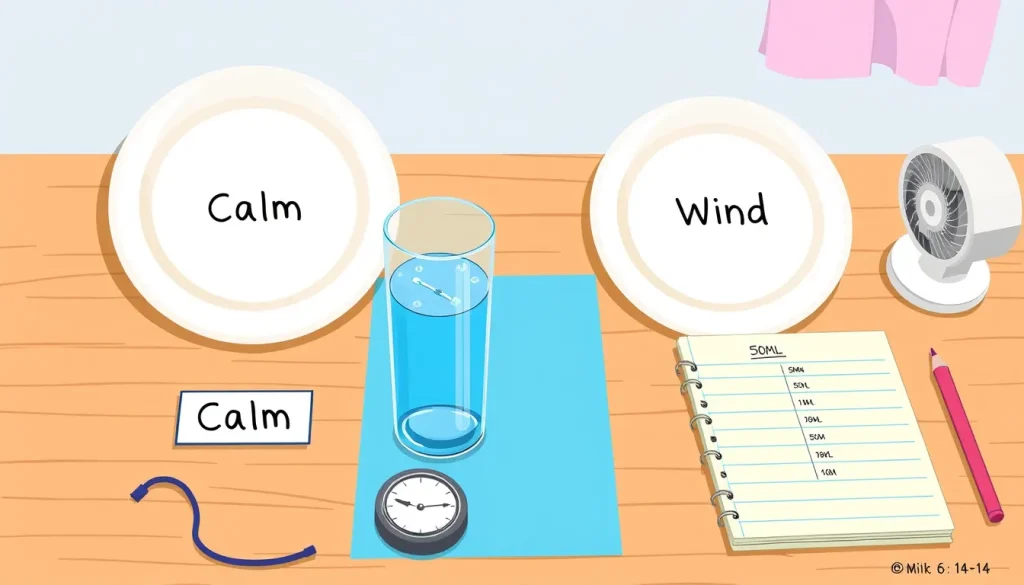
- Two identical paper plates or shallow paper dishes (same size and shape).
- Measuring cylinder or graduated cup (10 mL increments).
- Stopwatch or smartphone timer.
- Small desk fan with at least three speed settings, or a window that can be opened partially.
- Ruler or tape measure (optional, for measuring distance from fan to dish).
- Pen and worksheet for recording data (a table is provided below).
- Paper towels for cleanup.
Steps
- Label the two plates “Calm” and “Wind”.
- Using the measuring cylinder, pour exactly 50 mL of water onto each plate. Ensure the water spreads evenly to form a thin, uniform layer.
- Place the “Calm” plate on a flat surface away from any drafts – at least 1 m from the fan or open window.
- Place the “Wind” plate on a second flat surface directly in front of the fan (or near the open window). Set the fan to its lowest speed for the first trial.
- Start the stopwatch the moment the water is poured onto each plate.
- Observe each plate and note the exact moment when the water disappears completely (no visible liquid left). Record the time in seconds.
- When the water has evaporated, turn off the fan and let the “Calm” plate sit for a few minutes to ensure no residual moisture remains.
- Repeat the whole procedure two more times, each time increasing the fan speed (medium, then high). If using a window, repeat with the window opened a little wider for the next trial.
- Make sure you use a fresh 50 mL of water for each trial.
- Keep the distance between the fan and the plate the same for all fan‑speed trials (e.g., 15 cm).
- After the final trial, clean up any spilled water with paper towels and store the plates for later use.
What to Observe or Measure
Record the evaporation time (in seconds) for each airflow condition. The table below provides columns for:
- Trial number
- Airflow condition (Calm, Low, Medium, High)
- Measured evaporation time
- Notes (e.g., any splashing, temperature feel, fan noise)
Variables and Controls
- Independent variable: Airflow speed (calm, low, medium, high).
- Dependent variable: Time taken for 50 mL of water to evaporate.
- Controlled variables: Volume of water, surface area of the water layer, ambient temperature, humidity, and distance from the fan to the water surface. Using identical plates and the same amount of water keeps these factors constant.
- Control group: The “Calm” plate with no intentional airflow.
Testable Question
Does increasing the speed of moving air reduce the time required for a fixed volume of water to evaporate?

Hypothesis
Because moving air removes water‑vapour molecules from the surface more quickly, the evaporation time will become shorter as the fan speed increases.
Repeated Trials
Perform at least three trials for each airflow speed. Repeating the measurement helps reveal natural variation (e.g., slight temperature changes) and gives a more reliable average.
Data Table (blank for recording)
| Trial | Airflow Condition | Evaporation Time (s) | Notes |
|---|---|---|---|
| 1 | Calm | ||
| 2 | Calm | ||
| 3 | Calm | ||
| 1 | Low | ||
| 2 | Low | ||
| 3 | Low | ||
| 1 | Medium | ||
| 2 | Medium | ||
| 3 | Medium | ||
| 1 | High | ||
| 2 | High | ||
| 3 | High |
Graphing Your Results
Plot a simple column chart:
- X‑axis: Airflow condition (Calm, Low, Medium, High).
- Y‑axis: Average evaporation time (seconds).
- Each column shows the mean of the three trials for that condition. Adding error bars (range or standard deviation) helps visualise variability.
A downward trend – shorter times with faster airflow – supports the hypothesis.
The Science Explained
Evaporation occurs when molecules at the surface of a liquid gain enough energy to break free and become vapour. Two key factors control how quickly this happens:
- Temperature: Higher temperature gives molecules more kinetic energy, increasing the number that can escape.
- Air movement: Still air quickly becomes saturated with water vapour directly above the liquid surface, creating a “vapour‑pressure barrier” that slows further evaporation. A breeze or fan continuously replaces this saturated layer with drier air, maintaining a steep concentration gradient and allowing more molecules to leave the surface.1
In the experiment, the volume of water and its surface area stay the same, so any change in evaporation time is due to the altered airflow. Faster airflow means the water‑vapour is swept away more rapidly, so the liquid loses mass at a higher rate.
Other factors such as humidity and temperature should be kept as constant as possible. If you notice a large temperature rise from the fan, note it in the “Notes” column – it could also contribute to faster evaporation.
Troubleshooting
- Water never disappears: The airflow may be too weak or the room too humid. Try moving the fan closer or opening a window to increase the draft.
- Spillage creates uneven layers: Use a small spoon to spread the water gently so the layer stays uniform.
- Large variation between trials: Check that the room temperature is stable and that the fan speed setting does not change unintentionally.
Cleanup and Disposal
All water used is safe to pour down the sink. Wipe any spills with paper towels and recycle the paper plates if they are clean. Store the fan unplugged until the next use.
Next Steps
Children can extend the investigation by changing another variable, such as:
- Surface area – use larger or smaller dishes.
- Temperature – place plates in a sunny spot versus a shaded spot.
- Different liquids – compare water with alcohol or juice (with adult supervision).
These extensions deepen understanding of how multiple factors combine to affect evaporation, a process that shapes weather, drying of clothes, and even the water cycle on Earth.
Related terms
- Evaporation
- The process where liquid molecules gain enough energy to become gas without reaching boiling point.
- Airflow
- Movement of air that can carry away water vapour from a surface.
- Concentration gradient
- Difference in amount of a substance (e.g., water vapour) between two places; a steeper gradient speeds up diffusion.
Sources & references
- Investigating evaporation – Royal Society of Chemistry, https://edu.rsc.org/download?ac=514059
- Experiments On Evaporation & Surface Area – Sciencing, https://www.sciencing.com/experiments-evaporation-surface-area-10041602/