Overview
Gardeners and teachers often use plastic mulch to raise soil temperature, and research shows that the color of the plastic matters [1]. Cardboard is a cheap, biodegradable alternative that can be colored with paint, markers, or natural dyes. This experiment asks a simple, testable question: Does the color of cardboard covering the soil influence how warm the soil gets? By measuring temperature under white, brown, and black cardboard, children can see physics (light absorption) and earth‑science (soil heat) in action.
Before You Begin
- Choose a sunny day with little cloud cover (mid‑morning to early afternoon is ideal).
- Gather a flat, open area of garden or a large container filled with the same soil throughout.
- Make sure an adult is present to help with cutting cardboard, handling thermometers, and supervising any use of paint.
- Plan for at least 6 hours of observation (including setup and cleanup).
Materials
| Item | Quantity / Size |
|---|---|
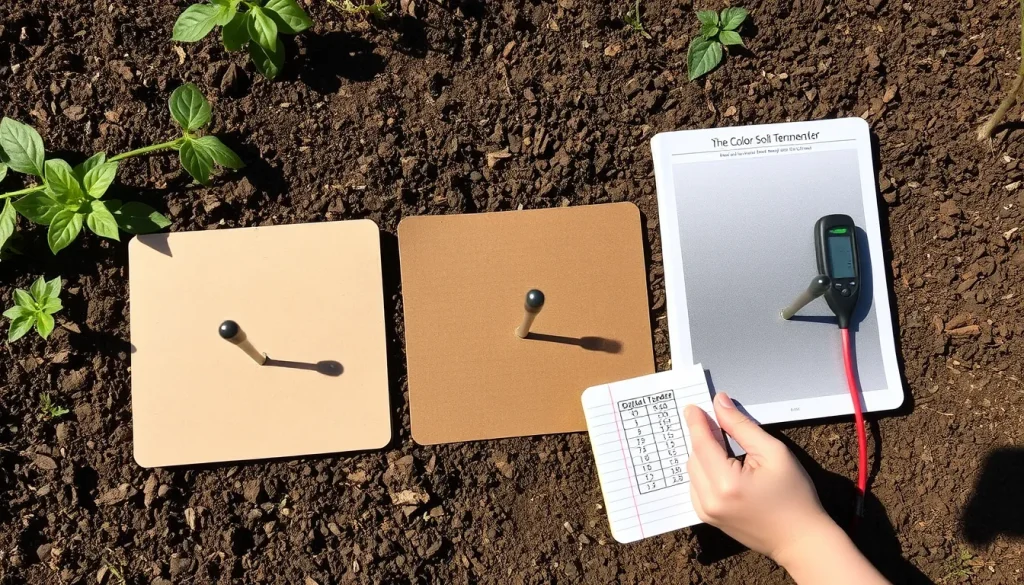
| Cardboard sheets | 3 sheets, 30 cm × 30 cm each (one white, one brown, one black) |
| Non‑toxic paint or markers | If you need to color the cardboard yourself |
| Soil thermometer or digital temperature probe | 1 (able to read to at least 0.1 °C) |
| Garden soil (or potting mix) | Enough to fill a 1 m² area to a depth of 10 cm |
| Ruler or measuring tape | 1 |
| Notebook or data sheet | 1 |
| Sunny day timer or watch | 1 |
All items are household‑common except the thermometer, which can be borrowed from a garden center.
Procedure (Steps)
- Lay out three equal‑sized plots of bare soil, spaced at least 30 cm apart.
- Label each plot “White”, “Brown”, and “Black”.
- Place a cardboard sheet of the matching color on each plot, making sure the sheet lies flat and covers the entire 30 cm × 30 cm area.
- Insert the thermometer probe vertically into the soil, positioning the tip about 5 cm below the cardboard surface. Record the exact depth.
- Start the timer at 10:00 am (or the time you begin). Record the soil temperature for each plot every hour for six hours (10 am, 11 am, …, 3 pm).
- After the final reading, carefully lift the cardboard, note any changes (e.g., wetness, deformation), and return the soil to its original state if you wish to repeat the experiment on another day.
What to Observe or Measure
- Soil temperature (°C) under each color at each hour.
- Weather conditions: cloud cover, wind, ambient air temperature (optional but helpful).
- Condition of the cardboard after the test (dry, soggy, torn).
Record all values in the data table provided below.
Testable Question
Does the color of cardboard placed on soil affect the soil temperature during a sunny day?

Hypothesis
Because dark surfaces absorb more sunlight while light surfaces reflect it, the hypothesis is: Black cardboard will produce the highest soil temperature, brown will be intermediate, and white will keep the soil coolest.
Variables and Controls
- Independent variable: Color of the cardboard (white, brown, black).
- Dependent variable: Soil temperature measured 5 cm below the cardboard.
- Controlled variables: Cardboard size and thickness, soil type and moisture, depth of thermometer probe, time of day for each reading, and weather conditions across the three plots.
Repeated Trials
To see whether the pattern holds under slightly different conditions, repeat the entire set‑up on two additional sunny days (at least three days apart). Keep the same cardboard pieces and soil area. This provides three independent trials, allowing you to notice day‑to‑day variation.
Data Table
| Time | White | Brown | Black |
|---|---|---|---|
| 10:00 am | |||
| 11:00 am | |||
| 12:00 pm | |||
| 1:00 pm | |||
| 2:00 pm | |||
| 3:00 pm |
Leave the cells blank while you conduct the experiment.
Graphing Your Results
Plot a line graph with time of day on the horizontal axis and soil temperature (°C) on the vertical axis. Draw a separate line for each cardboard color. The graph will make it easy to compare how quickly each color warms the soil and what the maximum temperature difference is.
The Science Explained
Sunlight carries energy in the form of visible and infrared radiation. When this radiation strikes a surface, part of it is reflected and part is absorbed. The proportion reflected is called the surface’s albedo. Light‑colored surfaces have high albedo and reflect most of the incoming light, while dark surfaces have low albedo and absorb more energy, converting it to heat.
Plastic mulch research shows that colored mulch can raise or lower soil temperature by several degrees, depending on its hue [1] and the way it modifies the surface energy balance [4]. Cardboard behaves similarly to thin plastic films, but it is porous and can retain moisture, which may influence heat transfer. By selecting cardboard of different colors, you are effectively changing the albedo of the soil surface.
When the cardboard absorbs sunlight, it warms the air layer directly under it and conducts heat into the soil. Darker cardboard conducts more heat because it absorbs a larger fraction of the solar spectrum. Conversely, white cardboard reflects most of the light, allowing the soil to stay cooler. The experiment demonstrates these principles with materials that are easy to find at home.
Troubleshooting
- Cloudy or windy day: If clouds block the sun, temperature differences may be small. Wait for a clear day or note the reduced solar input as a factor.
- Wet cardboard: Moisture can increase thermal conductivity, sometimes making a dark sheet feel cooler initially. Dry the cardboard before the next trial.
- Thermometer drift: Allow the probe to equilibrate for a minute after each insertion before reading.
- Uneven soil moisture: Water the entire area evenly the night before the test so that moisture does not bias results.
Cleanup and Disposal
After the experiment, remove the cardboard pieces. If the cardboard is clean and undamaged, recycle it according to local guidelines. If it has paint or soil on it, compost the soil‑soaked cardboard in a backyard compost bin or discard it in the green waste bin. Store the thermometer safely for future projects.
Next Steps
Kids can extend the investigation by:
- Testing additional colors (e.g., red, blue) or patterns.
- Varying the thickness of the cardboard (single‑layer vs. double‑layer).
- Comparing cardboard to a piece of clear plastic or no cover at all.
- Measuring plant growth or seed germination under each cover to see how temperature changes affect living organisms.
These extensions turn the simple temperature test into a broader study of how micro‑climates affect garden ecosystems.
Related terms
- Albedo
- The fraction of incoming sunlight that a surface reflects; light colors have high albedo, dark colors have low albedo.
- Mulch
- A covering placed on the soil surface to conserve moisture, suppress weeds, and modify temperature.
- Thermal conductivity
- A material’s ability to transfer heat; wetter materials usually conduct heat more quickly.
Sources & references
- Arancibia, R. (2022). Plastic Mulch Color and Soil Temperature. University of Missouri Extension. https://ipm.missouri.edu/MPG/2022/5/plasticMulch-RA/
- Ask Extension. (2024). Soil temperature – Should I use cardboard or plastic? https://ask.extension.org/kb/faq.php?id=869038
- Silva, F. F. da, Resende, A. S. de, Santos, T. A. dos, & Chaer, G. M. (2018). Use of Cardboard Disks for Crowning Seedlings in Reforestation. Floresta e Ambiente, 25(3), e20160261. https://www.scielo.br/j/floram/a/wWMz7SMB3d9JW64xGz8LbpJ/?format=pdf&lang=en
- Jones, H., Black, A., & Jassal, P. (2018). Plastic Mulches and Soil Temperature. UBC Farm Factsheet. https://bcfoodweb.ca/sites/default/files/res_files/FI07-2018-factsheet-Plastic-Mulches1.pdf