Understanding why objects stay upright—or tumble over—is a fundamental physics concept. The key idea is the center of mass (CoM): the average location of all the mass in a body. As long as the CoM lies vertically above the base of support, gravity creates no overturning torque and the object remains stable. When the CoM moves past the edge of the base, a torque appears and the structure tips. This experiment lets families explore that principle with everyday items: cardboard, wooden blocks, and sandbags.
Overview
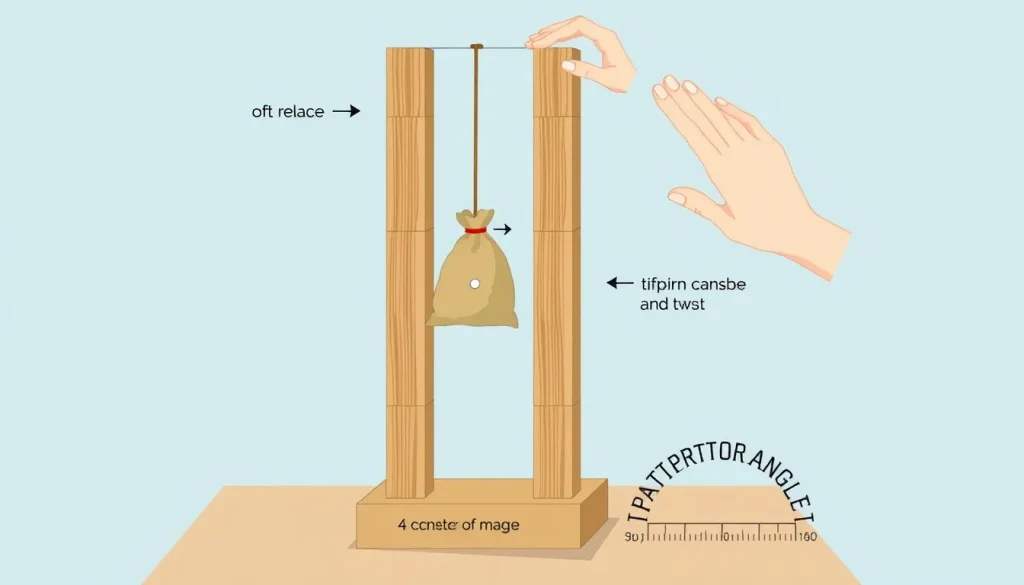
Participants will build a simple tower on a square cardboard base, then attach a sandbag at varying heights. By gently nudging the tower, they will record the angle at which it begins to tip. Repeating the test with the sandbag at different positions shows a clear relationship between CoM height and stability. The activity aligns with the physics demonstrations described in the Tower Stability Lab and the Center of Mass Tower at Western Washington University, which illustrate the same tipping principle.12
Before You Begin
- Choose a flat, sturdy work surface (a table or floor).
- Gather all materials and lay them out so each child can reach them safely.
- Adult supervision is required for cutting cardboard, handling scissors, and for any weighing of sandbags.
- Set up a simple data‑recording sheet (provided in the Data Table section) and a pencil.
Materials
- 1 piece of sturdy cardboard (minimum 30 cm × 30 cm) – serves as the base.
- 6–8 uniform wooden blocks (e.g., 5 cm × 5 cm × 10 cm) – to build the tower.
- 2 small sandbags (each ~250 g of sand, sealed in a zip‑top bag).
- Thin rope or string (≈30 cm) to hang the sandbag from the tower.
- Ruler or measuring tape.
- Masking tape or painter’s tape.
- Protractor (optional, for measuring tilt angle).
- Notebook or printed data sheet.
Testable Question
How does the height at which a sandbag is attached to a tower affect the angle at which the tower begins to tip over?
Hypothesis
If the sandbag is placed higher on the tower, then the tower will tip at a smaller tilt angle because the center of mass moves farther from the base, creating a larger overturning torque.2

Variables and Controls
- Independent variable: Height of the sandbag measured from the base (e.g., 5 cm, 10 cm, 15 cm, 20 cm).
- Dependent variable: Tilt angle (in degrees) at which the tower first loses balance.
- Controlled variables:
- Mass of each sandbag (kept constant).
- Number and size of wooden blocks used to build the tower.
- Base dimensions and material (same cardboard piece for every trial).
- Method of nudging the tower (use a gentle, consistent push with the same hand).
Procedure (Steps)
- Cut the cardboard into a square base (30 cm × 30 cm). Tape the edges to keep the base rigid.
- Arrange the wooden blocks in a straight vertical column on the center of the base. Secure each block to the one below with a small piece of tape so the tower does not wobble during handling.
- Measure and mark four heights on the side of the tower (e.g., 5 cm, 10 cm, 15 cm, 20 cm from the base). These will be the positions where the sandbag will be attached.
- Attach a length of string to the sandbag and tie the other end to the tower at the first marked height. Ensure the sandbag hangs freely without touching the base.
- Place the tower on a smooth surface. Using a ruler, confirm the tower stands upright (no visible lean).
- Gently push the tower from the side, increasing the push until the tower begins to rotate. Observe the point where the tower’s base edge lifts off the ground or where the tower starts to fall.
- If you have a protractor, place it on the floor next to the base and record the angle between the base and the floor at the moment of tipping.
- If no protractor is available, estimate the angle by noting the tilt (e.g., “small tilt,” “medium tilt,” “large tilt”) and later convert to degrees using a simple diagram.
- Record the tilt angle (or qualitative estimate) in the data table.
- Return the tower to the upright position, remove the sandbag, and repeat steps 4–8 for the next height mark.
- Perform at least three trials for each sandbag height to capture variation.
- After all measurements are collected, calculate the average tipping angle for each height.
What to Observe and Measure
- Tilt angle at the moment the tower starts to tip (degrees or qualitative category).
- Height of the sandbag from the base (centimeters).
- Any noticeable wobble before tipping (optional note).
Data Table
| Trial # | Sandbag Height (cm) | Tipping Angle (°) or Qualitative |
|---|---|---|
| 1 | ||
| 2 | ||
| 3 |
Repeated Trials
Repeating each height three times helps reveal random variation (e.g., small differences in push force). After the three trials, compute the mean angle and note the range (maximum – minimum). This provides a more reliable picture of how height influences stability.
Graphing Your Results
Plot a simple line graph:
- X‑axis: Sandbag height (cm).
- Y‑axis: Average tipping angle (°).
- Each point represents the mean angle for that height; error bars can show the range.
The graph should show a downward trend: higher sandbag positions produce smaller tipping angles, confirming the hypothesis.
The Science Explained
The tower remains stable while the line drawn vertically from its center of mass falls inside the rectangle formed by the base. Gravity pulls straight down through the CoM. When the tower leans, the CoM shifts horizontally. If the projected line still lands inside the base, a restoring torque pushes the tower back upright. Once the projection moves outside the base edge, the torque reverses direction and the tower continues to fall.2
Adding a sandbag raises the overall CoM because the sand’s mass is now higher up. The higher the CoM, the smaller the angle needed for its projection to exit the base. Mathematically, the overturning torque τ = F · d, where F is the weight (mg) and d is the horizontal distance from the base edge. Raising the sandbag increases d for a given tilt, so τ reaches the critical value sooner.
Troubleshooting
- Tower falls immediately, even with no sandbag: Check that the blocks are centered on the base and that the base is level. Adjust the tape to keep the tower vertical.
- Sandbag slides down the tower: Use a short piece of string to tie the bag securely, or add a small notch in the block where the string can rest.
- Inconsistent tilt angles between trials: Use the same hand and the same gentle, steady push each time. Mark a spot on the table where you place your hand for consistency.
- Unable to measure angle accurately: Draw a small protractor on a piece of cardboard and place it against the base after each trial, or take a photo and measure the angle later with a free app.
Try Another Version
For a deeper engineering challenge, redesign the tower using a triangular or rectangular frame made from straws and paper clips, then repeat the sandbag test. Compare how different structural shapes affect the tipping point while keeping the sandbag mass constant.
Cleanup and Disposal
- Collect all sandbags, empty the sand back into a storage container, and reseal.
- Recycle the cardboard base and wooden blocks if they are not needed for future projects.
- Store the string, tape, and measuring tools for later use.
Next Steps
After confirming the relationship between CoM height and stability, extend the investigation by varying the sandbag’s mass instead of its height, or by adding a horizontal “earthquake” shake using a tray shaker. Both extensions deepen understanding of how forces and mass distribution govern real‑world structures such as buildings and bridges.
Related terms
- Center of mass
- The average position of all the mass in an object; gravity acts through this point.
- Base of support
- The area of contact between an object and the surface beneath it.
- Stable equilibrium
- A condition where a small disturbance creates a restoring force that returns the object to its original position.
- Tipping point
- The moment when the center of mass moves outside the base of support, causing the object to rotate and fall.