Testable Question
Which seed type produces the first visible root the quickest when germinated in an identical rolled paper towel tube?
Hypothesis
Because fast‑growing seeds such as radish and mung bean have thin seed coats and high internal energy reserves, they will sprout earlier (within 2‑3 days) than larger seeds like sunflower or pea, which often need more water uptake before the radicle emerges.
Variables and Controls
- Independent variable: Seed species (radish, lettuce, bean, sunflower, etc.).
- Dependent variable: Time (in hours) from the start of the test to the appearance of the first root that is at least 2 mm long.
- Controlled variables:
- Amount of water in each towel (damp but not dripping).
- Temperature of the environment (keep near 75 °F/24 °C, e.g., on top of the refrigerator).
- Light exposure (store all tubes in a dark cabinet or inside a zip‑top bag).
- Number of seeds per tube (use the same count, e.g., five seeds, for each species).
- Size of the paper towel tube (same length and diameter for every sample).
- Control group: A tube with no seeds, to verify that any observed “roots” are not fungal hyphae or paper fibers.
Steps (Procedure)
- Label a zip‑top bag or a small piece of masking tape with the name of each seed type.
- Lay a single paper towel flat on a clean surface. Using a measuring cup, add water until the towel is thoroughly damp but not dripping (the paper should feel moist to the touch, similar to a squeezed‑wet sponge).
Tip: A spray bottle works well for even moisture [1]. - Place five seeds of the first species evenly spaced on one half of the towel. Fold the towel over the seeds, creating a “sandwich.”
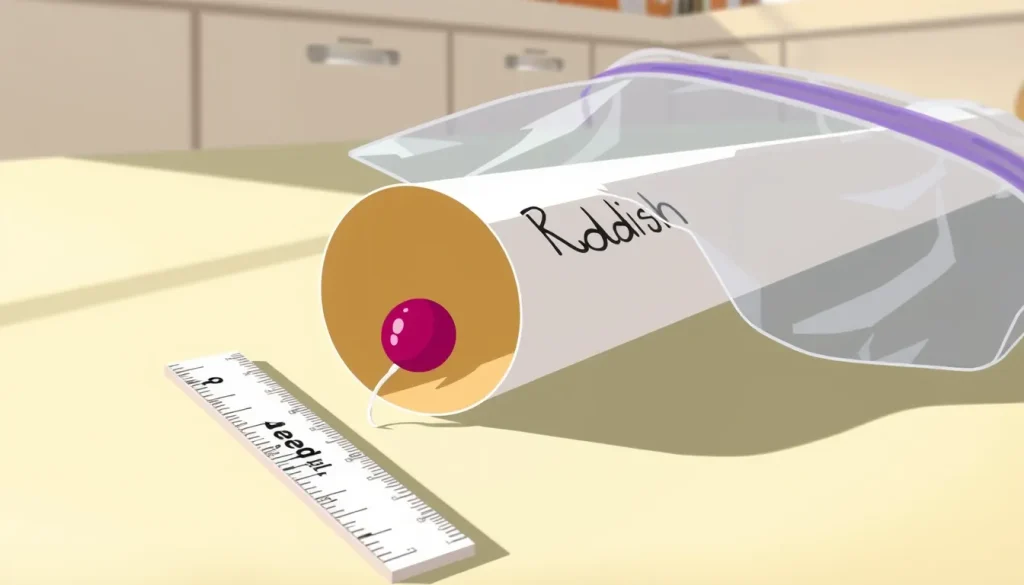
- Roll the towel tightly from one end to the other, forming a tube about 2‑3 inches (5‑8 cm) in diameter. Secure the roll with a rubber band or twist tie.
- Insert the rolled tube into its labeled zip‑top bag (optional but helps retain humidity). Seal the bag loosely—enough air can move to prevent mold, but enough moisture stays inside.
- Repeat steps 2‑5 for each seed type, using a fresh towel for each. Also prepare a “blank” tube with no seeds as the control.
- Place all tubes in a warm, dark spot (e.g., on top of the refrigerator or inside a cupboard) where the temperature stays around 75 °F (24 °C).
- Start a timer. Every 12 hours (morning and evening), open each bag briefly, look for the first sign of a white root emerging from the paper, and record the time. If you have a ruler, note the root length; otherwise, simply note “visible.”
- Continue observations for up to 10 days or until every seed type has produced at least one root.
- When the experiment ends, gently unroll the towels and photograph each tube for documentation (optional).
What to Observe or Measure
- First‑root time: Record the hour count when the first root of any seed in a tube becomes visible (minimum 2 mm).
- Root length (optional): Measure the longest root in each tube at the end of the trial.
- Germination rate (optional): Count how many of the five seeds in each tube eventually sprout. This provides a secondary view of seed viability.
- Conditions log: Note the ambient temperature each day (use a thermometer) and any visible signs of mold or drying.
Data Table (Blank)
| Trial # | Seed Type | First Root Observed (hours) | Root Length at Day 5 (mm) – optional | Seeds Germinated (out of 5) – optional |
|---|---|---|---|---|
| 1 | ||||
| 2 | ||||
| 3 |
Repeated Trials
Perform at least three independent trials for each seed species. Each trial uses a fresh set of seeds and a new towel roll. Repetition reduces the impact of random factors such as slight differences in seed moisture content or tiny temperature fluctuations.
The Science Explained
Seeds contain a dormant embryo protected by a seed coat. When water penetrates the coat (a process called imbibition), enzymes become active, starches are converted to sugars, and the radicle pushes outward. The speed of this chain depends on three main factors:
- Seed coat permeability. Thin, permeable coats (e.g., radish) let water in quickly, while thick, waxy coats (e.g., sunflower) delay imbibition.
- Stored energy reserves. Small seeds that are “ready to grow” often contain more readily mobilizable carbohydrates, so the embryo can power root growth faster.
- Temperature. Enzyme activity roughly doubles with every 10 °C rise (Q10 rule). Keeping the tubes at a warm 21‑27 °C (70‑80 °F) gives all seeds a fair chance to germinate quickly [1].
By controlling water, temperature, and darkness, the rolled paper towel tube isolates seed‑intrinsic differences, letting children see which species are naturally quicker.
Troubleshooting
- No roots after 7 days? Check that the towel is still moist; a dry towel stops imbibition. Re‑wet gently with a spray bottle.
- Mold appears? Reduce humidity by opening the zip‑top bag for a few minutes each day, or use a fresh towel for the next trial.
- Roots look like paper fibers? Compare with the blank control tube. If the control shows similar white strands, the observed “roots” may be paper fibers; only true roots will grow from a seed and be slightly thicker and green at the tip.
- Seeds are unusually old or stored in a warm place? Older seeds may have reduced viability. Consider running a simple germination test on a few seeds before the full experiment [2] (source not required for the main activity).
Next Steps
After identifying the fastest‑sprouting seed, children can explore why that seed is quick. Possible extensions include:
- Testing the effect of light: move some tubes to a sunny windowsill after the first root appears and compare growth speed.
- Trying scarification (lightly filing the seed coat) on a slow‑germinating species to see if breaking the coat speeds up emergence (see mimosa seed scarification discussion [4]).
- Measuring how temperature changes (e.g., placing tubes on a warm plate vs. a cool countertop) affect each species.
These follow‑up investigations turn the simple observation into a full science‑fair project, reinforcing experimental design, data analysis, and the biology of plant growth.
Sources & references
- Davidov, Dina. “How to Germinate Seeds in a Paper Towel: Step by Step.” DinasGarden.com, 11 September 2024. https://dinasgarden.com/how-to-germinate-any-seed-using-the-paper-towel-method/
- Cooperative Extension Service, University of Alaska Fairbanks. “Procedures for the Wet Paper Towel Germination Test.” https://www.uaf.edu/ces/publications/database/gardening/procedures-wet-towel-germ.php