Overview
Mulch – a layer of material placed on top of bare soil – is widely used in gardens to keep soil moist, suppress weeds, and protect roots from temperature extremes. Research shows that coarse organic mulches such as shredded wood or wood chips are especially good at reducing evaporative water loss, while fine or waxy mulches can become hydrophobic and actually repel water [1]. This experiment lets families test the basic claim: Does mulch reduce the amount of water that evaporates from soil?
Testable Question
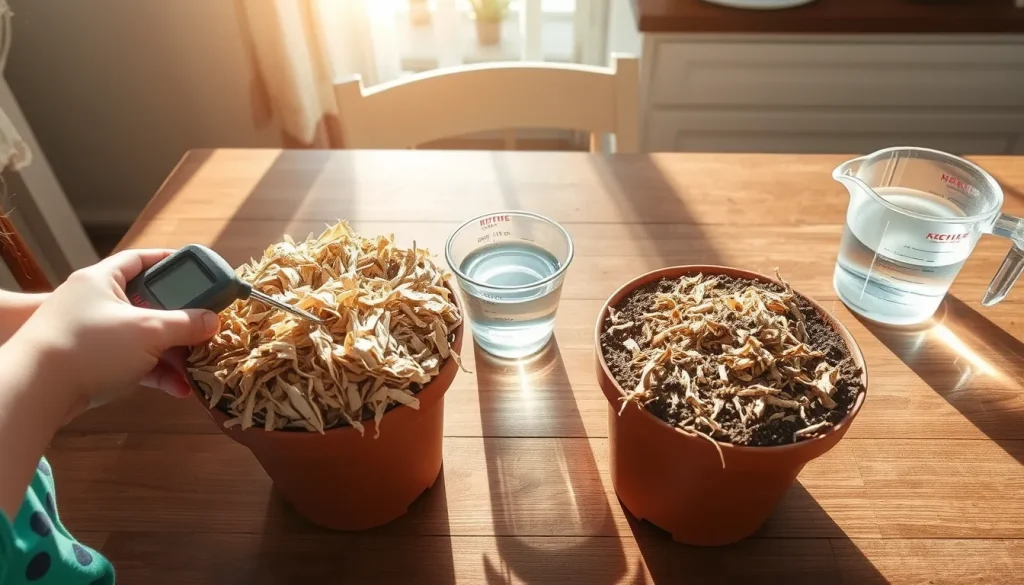
When two identical pots of soil are watered equally, does a pot covered with a layer of cardboard‑newspaper mulch retain more moisture after 24 hours than a pot left uncovered?
Hypothesis
Because mulch blocks direct sunlight and wind from reaching the soil surface, the mulched pot will lose less water to evaporation and therefore will have a higher soil‑moisture reading after 24 hours.
Materials
- Two identical plastic or terra‑cotton pots (≈15 cm diameter)
- Potting mix or garden soil (enough to fill each pot to the same depth)
- Water (room‑temperature)
- Measuring cup (100 ml)
- Kitchen scale (optional, for more precise water‑mass measurement)
- Cardboard or newspaper (cut into 1‑cm‑thick sheets, enough to cover the surface of one pot)
- Ruler or tape measure (to record soil depth)
- Soil moisture meter or simple gravimetric method (see below)
- Notebook or printed data table (provided)
- Pen or pencil
Before You Begin
Gather all materials on a table that stays dry for the duration of the test. An adult should supervise any cutting of cardboard or handling of the scale. If you use a commercial soil‑moisture meter, read the manufacturer’s safety notes – most are battery‑powered and safe for children.
Procedure
- Fill both pots with the same amount of dry soil (e.g., 500 g). Level the surface and record the soil depth.
- Water each pot with exactly 100 ml of water. Use the measuring cup and pour slowly so that water infiltrates the soil rather than running off.
- Place the cardboard or newspaper sheets on the surface of one pot, covering it completely. Leave the other pot uncovered – this is your control.
- Mark the start time (e.g., 9:00 AM). Keep the pots in the same location, away from direct drafts but under normal indoor lighting or outdoor shade.
- After 24 hours, measure the remaining soil moisture in each pot. Two simple methods are offered:
- Gravimetric method: Gently scrape off the top 2 cm of soil into a pre‑weighed container, weigh it, then dry it in an oven or sunny spot for several hours and weigh again. The loss of mass equals water evaporated.
- Moisture meter: Insert the probe into the soil at the same depth in each pot and record the meter reading.
- Record the moisture values in the data table below.
- Repeat the whole experiment two more times (three trials total) to see how consistent the result is.
What to Observe or Measure
For each trial record:
- Initial water volume added (ml)
- Final moisture reading (percentage from meter or water loss in grams)
- Ambient temperature and relative humidity (optional, note on the side of the notebook)
Data Table
| Trial | Pot Type | Initial Water (ml) | Final Moisture (% or g water lost) | Notes (temp, humidity) |
|---|---|---|---|---|
| 1 | Mulched | |||
| 1 | Un‑Mulched (Control) | |||
| 2 | Mulched | |||
| 2 | Un‑Mulched (Control) | |||
| 3 | Mulched | |||
| 3 | Un‑Mulched (Control) |
Graphing Your Results
Plot each trial on a simple bar graph: the x‑axis lists “Mulched” and “Control”, the y‑axis shows remaining moisture (or water lost). Bars that are higher for the mulched pots indicate less water loss. A visual comparison makes the trend easy to discuss.
Variables and Controls
- Independent variable: Presence or absence of mulch.
- Dependent variable: Amount of water retained in the soil after 24 hours.
- Controlled variables: Pot size, soil type, initial water volume, ambient temperature, exposure to light, and measurement method.
- Control group: The pot without mulch.
Repeated Trials
Running three trials reduces the chance that a single odd weather condition (e.g., a sudden draft) skews the data. Compare the three results; if they all point to the same direction, the evidence is stronger.
The Science Explained
Mulch works primarily by covering the soil surface. This cover reduces direct solar heating, which in turn lowers the temperature gradient that drives evaporation. It also blocks wind, another driver of water loss, and limits the formation of a dry crust that can channel water runoff instead of infiltration [1]. Coarse, porous organic mulches allow water to infiltrate while still providing a barrier to evaporation; fine or waxy mulches can become hydrophobic, repelling water and decreasing effectiveness [1]. Studies have shown that applying 6–10 Mg ha⁻¹ (megagrams per hectare) of organic mulch markedly reduces soil‑loss and runoff, confirming the practical impact of adequate mulch depth [2]. In short, a mulch layer creates a micro‑environment that conserves soil moisture, which is exactly what this experiment demonstrates.
Troubleshooting
- Moisture meter reads the same for both pots: Ensure the probe is inserted to the same depth each time and that the meter is calibrated.
- Water runs off the soil surface: Add water slowly, pause to allow it to soak in, or use a finer‑grained soil that retains water better.
- Mulch shifts or falls off: Weigh down the edges with a small rock or press the cardboard gently into the soil before the start.
- Large temperature swings during the 24‑hour period: Conduct the experiment indoors or note the temperature changes in the “Notes” column.
Cleanup and Disposal
The soil can be composted or used for a later planting project. Cardboard or newspaper mulch can be added to a backyard compost pile; if composting is not an option, recycle the paper according to local guidelines. Wash the measuring cup and any reusable tools with soap and water.
Next Steps
Try the same test with different mulch types – straw, wood chips, or a synthetic rubber mulch – and compare which material conserves the most water. You can also vary the mulch thickness (e.g., 1 cm vs. 3 cm) to see how depth influences results, linking back to the research that recommends a certain application rate for optimal performance [2].
Related terms
- Mulch
- A layer of material—organic or inorganic—spread over soil to conserve moisture, suppress weeds, and regulate temperature.
- Evaporation
- The process by which water changes from liquid to vapor and escapes from the soil surface.
- Soil moisture
- The amount of water held in the soil, which plants can absorb for growth.
Sources & references
- Kelly Feehan, "Landscape Mulch for Water Conservation," UNL Water, April 30, 2024, https://water.unl.edu/article/lawns-gardens-landscapes/landscape-mulch-water-conservation/
- Review of organic mulching effects on soil and water loss, Archives of Agronomy and Soil Science, 2020, https://doi.org/10.1080/03650340.2020.1718111
- Tiago B. Ramos et al., "Mulching effects on soil evaporation, crop evapotranspiration and crop coefficients: a review aimed at improved irrigation management," Irrigation Science, March 11, 2024, https://doi.org/10.1007/s00271-024-00924-8
- David A. Shaw et al., "Water Retention and Evaporative Properties of Landscape Mulches," UC ANR, 2011, https://www.ucanr.edu/sites/default/files/2011-03/80238.pdf