Overview
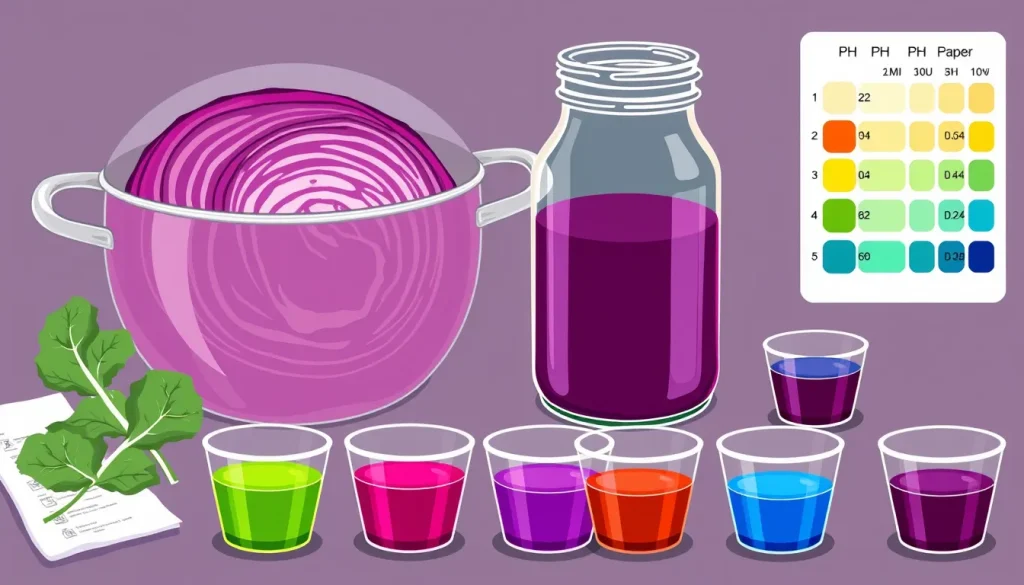
Red cabbage contains pigments called anthocyanins that change colour depending on the acidity (pH) of the solution they are placed in. When the cabbage is boiled, the pigments dissolve into the water, creating a purple‑blue liquid that works as a universal pH indicator. In acidic solutions the colour shifts toward pink/red, in neutral solutions it stays purple, and in alkaline solutions it turns green‑yellow. This natural indicator is inexpensive, safe, and gives a visual way to explore acids, bases, and the pH scale.
Testable Question
How does the colour change of red‑cabbage juice compare with the pH values reported by commercial pH paper for a range of common household liquids?
Hypothesis
Because anthocyanins respond to hydrogen‑ion concentration, the colour of the cabbage juice will match the pH paper reading within about 0.2 pH units for most liquids, as reported in recent studies [4].
Materials
- ½ head red cabbage (or a bag of pre‑cut cabbage)
- Water (≈500 ml for boiling, plus extra for diluting)
- Medium‑sized pot with lid
- Stove or hot plate (adult supervision required)
- Strainer or cheesecloth
- Clear glass jars or plastic cups (one per test liquid)
- Dropper or small spoon for adding indicator
- Household liquids to test (e.g., white vinegar, lemon juice, baking‑soda solution, liquid soap, milk, tap water, soda, etc.)
- Commercial pH paper strips (optional but recommended for comparison)
- Paper towels or cloth for cleaning
- Protective apron or old shirt
Safety and Preparation (Before You Begin)
- Adult must handle the hot pot and boiling water.
- Wear eye protection if splashing is possible.
- Ensure the workspace is well‑ventilated and surfaces are protected from spills.
- Prepare a clean area for the test tubes/cups and keep a waste bucket nearby.
Procedure
- Cut the red cabbage into roughly 2‑cm pieces. No need to be precise.
- Place the cabbage pieces in the pot and add enough water to just cover them (≈500 ml).
- Bring to a boil, then reduce to a simmer and cover for 10 minutes. The water will turn deep purple.
- Remove the pot from heat and let it cool for a few minutes.
- Strain the liquid through a fine sieve or cheesecloth into a clean container. This is your cabbage‑juice indicator.
- Label each test cup with the name of the liquid you will add.
- Pour a small amount (≈20 ml) of each household liquid into its cup.
- Add 3–5 drops of cabbage‑juice indicator to each cup, swirl gently, and record the colour that appears.
- If you have pH paper, dip a strip into each liquid (before adding the indicator) and note the colour match on the paper’s reference chart.
- Clean up as described below.
What to Observe and Record
For each liquid note the following:
| Sample | Observed colour (cabbage juice) | Estimated pH (from colour chart) | pH paper reading (if used) |
|---|---|---|---|
Typical colour‑to‑pH associations (from RHS and university sources) are:
- Pink/red – strong acid (pH < 3)
- Red‑orange – weak acid (pH ≈ 4‑5)
- Purple – neutral (pH ≈ 7)
- Green – mildly alkaline (pH ≈ 8‑9)
- Yellow‑green – strong base (pH > 10)
Variables and Controls
- Independent variable: the type of household liquid being tested.
- Dependent variable: the colour of the cabbage‑juice indicator and the estimated pH.
- Controlled variables: amount of indicator added, volume of test liquid, temperature of the indicator (use at room temperature), and the colour‑reference chart used for estimating pH.
- Control sample: a cup of distilled or tap water, which should remain purple (pH ≈ 7).
Analyzing the Results
Compare the estimated pH from the colour chart with the pH paper reading (if you used paper). A difference of ≤0.2 pH units indicates good agreement, matching the findings of a recent Ohio Academy of Science study [4]. Discuss any discrepancies – possible causes include dilution of the indicator, lighting conditions, or the limited colour resolution of the chart.
If you wish to visualise the data, plot “Sample” on the horizontal axis and “Estimated pH” on the vertical axis. Bar charts work well for categorical samples.
Troubleshooting
- Indicator colour is muddy or brown: the cabbage may have been over‑cooked or the liquid left on the heat too long. Prepare a fresh batch and keep the simmer gentle.
- No colour change observed: the indicator may be too dilute. Add a few more drops of the cabbage juice to the test cup.
- pH paper and indicator give very different values: ensure the paper is fresh (expires) and that you dip it into the liquid before adding the indicator, because the indicator itself can slightly shift the pH.
Cleanup and Disposal
- Dispose of the used cabbage‑juice solution down the sink with plenty of water.
- Rinse all cups and the pot with warm soapy water.
- Wipe the work surface with a damp cloth.
- Store any remaining indicator in a sealed jar in the refrigerator; it will stay usable for a few days.
Next Steps
Extend the investigation by testing how dilution affects the colour intensity, or by creating a calibrated colour‑to‑pH chart using standard buffer solutions (0.1 M HCl and 0.1 M NaOH). Older students can also explore the chemistry behind anthocyanins and why they change colour with pH.
Related terms
- pH
- A numeric scale from 0 to 14 that measures how acidic or basic a solution is; 7 is neutral.
- Acid
- A substance that increases the concentration of hydrogen ions (H⁺) in water, giving a pH below 7.
- Base
- A substance that reduces hydrogen‑ion concentration, often increasing hydroxide ions (OH⁻), giving a pH above 7.
- Indicator
- A chemical that changes colour depending on the pH of the solution it is in.
Sources & references
- Royal Horticultural Society, Red cabbage indicator, https://www.rhs.org.uk/education-learning/school-gardening/resources/curriculum-linked/red-cabbage-indicator
- University of Oxford, Using Food as Natural Indicators, https://www.chem.ox.ac.uk/sitefiles/food-indicators-jul23.pdf
- University of Massachusetts Amherst, Natural Acid/Base Indicators: Red Cabbage Juice Extract, https://lecturedemos.chem.umass.edu/chemReactions4_9A.html
- Ohio Academy of Science, How Accurate is Red Cabbage Juice in Testing pH Compared to pH Paper?, https://partner.projectboard.world/oas/project/how-accurate-is-red-cabbage-juice-in-testing-ph-compared-to-ph-paper-mzybpe