Overview
Plants constantly monitor their surroundings and adjust growth to maximise survival. One of the most visible responses is phototropism – the tendency of shoots to grow toward light. By comparing seedlings grown under different light directions you can see this response in action and collect data that illustrate how the plant hormone auxin drives the curvature.[1][2][3]
Before you begin
- Choose a well‑ventilated workspace with a flat surface.
- Adult supervision is recommended for handling hot water, cutting cardboard, and using a lamp.
- Gather all materials before starting; the experiment takes about 30 minutes to set up, then 4–7 days of observation.
Materials
- Fast‑germinating seeds (e.g., cress, mustard, or radish) – 30 seeds per treatment.
- Paper towels (plain kitchen paper) – 3 sheets.
- Clear plastic trays or shallow dishes – 3.
- Water in a spray bottle or a small jug.
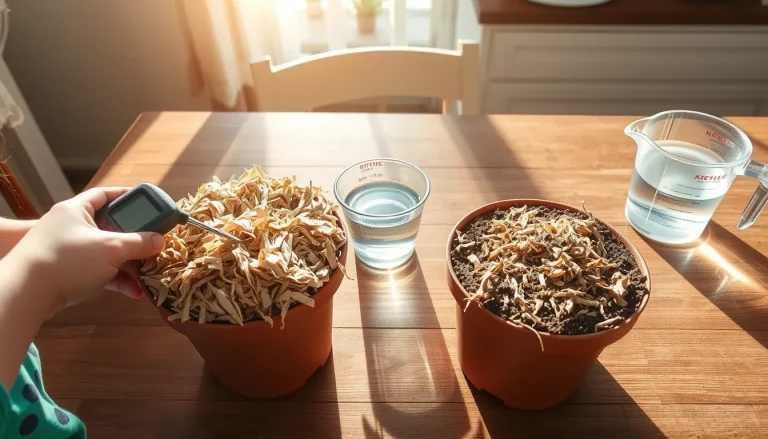
- Cardboard box (shoe box size) to create darkness.
- Desk lamp or a sunny windowsill.
- Ruler (cm) and protractor (°) for measuring length and curvature.
- Permanent marker and labels.
Testable question
How does the direction of light (unilateral, overhead, or none) affect the curvature of a seedling’s shoot over a period of five days?
Hypothesis
If seedlings receive light from one side only, the shoot will bend toward that side, producing a larger curvature angle than seedlings illuminated from above or kept in darkness.
Variables and controls
- Independent variable: Direction of light (side, top, dark).
- Dependent variable: Shoot curvature angle (degrees) measured from the vertical.
- Controlled variables: Seed type, number of seeds, moisture level, temperature, container size, observation period.
- Control group: The “overhead light” treatment, representing the normal vertical growth pattern.
Procedure (Steps)
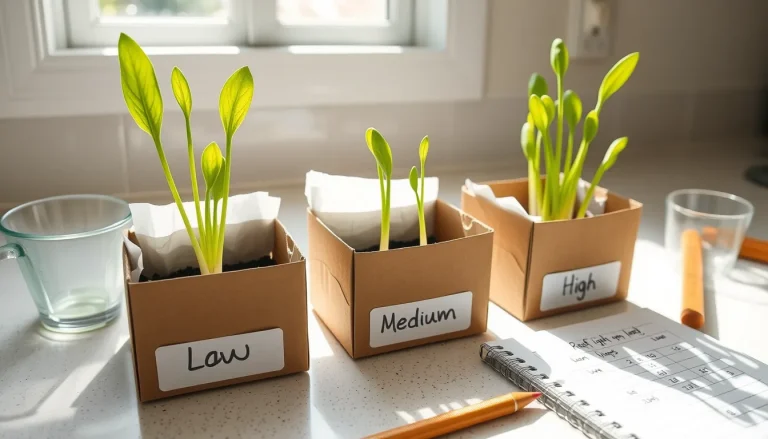
- Label three trays as “Side Light”, “Overhead Light”, and “Dark”.
- Place a damp paper towel in each tray. Moisten it until it is wet but not pooling.
- Spread 30 seeds evenly on each towel, pressing them gently into the surface.
- Cover the trays with a second damp paper towel to maintain humidity.
- Set up the lighting conditions:
- Side Light: Position a desk lamp 5 cm from the side of the tray, creating a narrow slit of light across the seeds.
- Overhead Light: Place a lamp directly above the tray (or put the tray on a sunny windowsill) so light falls uniformly from the top.
- Dark: Place the tray inside the cardboard box and seal the lid; poke a small vent to avoid excess humidity.
- Start the observation clock (Day 0). Keep the room temperature between 18–22 °C and avoid moving the trays.
- Each day for five days, record the curvature of five randomly chosen seedlings per tray (see “What to observe or measure”). Use the ruler to note shoot length and a protractor to measure the angle between the shoot tip and the vertical line.
- Re‑moisten the paper towels as needed (usually once every 48 hours) to prevent drying.
- After Day 5, stop measurements and photograph each tray for a visual record.
What to observe or measure
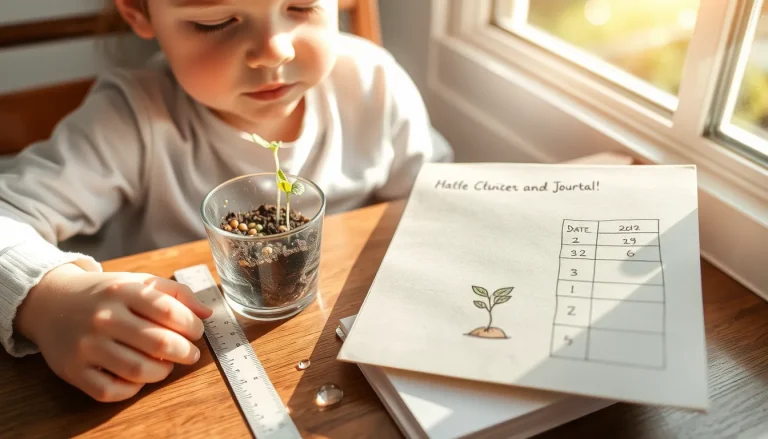
- Curvature angle (°): Place a ruler vertically behind the seedling and measure the angle formed by the shoot tip relative to the ruler.
- Shoot length (cm): Measure from the seed base to the tip.
- Qualitative notes: Record any wilting, discoloration, or unusual growth patterns.
Use the table below to log daily data.
Data table
| Day | Treatment | Seedling # | Curvature angle (°) | Shoot length (cm) |
|---|---|---|---|---|
| 1 | Side Light | 1 | ||
| 1 | Side Light | 2 | ||
| 1 | Side Light | 3 | ||
| 1 | Side Light | 4 | ||
| 1 | Side Light | 5 |
Repeated trials
To see how consistent the response is, repeat the whole set‑up on a second day with a fresh batch of seeds. Compare the two data sets; similar patterns strengthen confidence in the result, while large differences may point to uncontrolled factors (e.g., temperature fluctuations).
Graphing your results
Create a bar chart that shows the average curvature angle for each treatment after five days. Plot:
- X‑axis: Light treatment (Side, Overhead, Dark).
- Y‑axis: Mean curvature angle (°).
Adding error bars (standard deviation) helps illustrate variation between seedlings.
The science explained
When light hits only one side of a shoot, the plant hormone auxin accumulates on the shaded side. Auxin promotes cell elongation, so cells on the dark side grow faster than those on the illuminated side. This differential growth makes the shoot bend toward the light source – a classic example of phototropism.[1][2][3] In Arabidopsis seedlings, researchers measured that curvature results from an increased elongation rate on the shaded side and a decreased rate on the lighted side, followed by a straightening phase where the pattern reverses.[2] The same principle operates in fast‑germinating seedlings like cress, which is why the experiment produces a visible bend within a few days.
Troubleshooting
- Seedlings do not bend: Check that the light source is strong enough; a dim lamp may not create a clear unilateral gradient.
- Paper towel dries out: Re‑moisten daily; seedlings need constant moisture to keep the hypocotyl flexible.
- Excess heat from the lamp: Keep the lamp at least 10 cm away to avoid wilting.
- Uneven seed spacing: Randomly select seedlings for measurement to avoid bias from crowding.
Try another version
For older learners, replace the simple lamp with coloured filters (red, blue, green) to investigate whether light colour influences the magnitude of phototropism. Alternatively, use a rotating platform (clinostat) to separate the effects of gravity from light direction.
Cleanup and disposal
Discard used paper towels in the compost if possible; otherwise place them in the regular waste bin. Rinse the trays with water and let them dry for future use.
Related terms
- Phototropism
- Growth movement of a plant organ toward (positive) or away from (negative) a light source.
- Auxin
- A plant hormone that promotes cell elongation; its uneven distribution causes curvature.
- Hypocotyl
- The stem-like part of a seedling between the seed leaves (cotyledons) and the root.
- Curvature angle
- The angle between a seedling’s shoot and a vertical reference line, measured in degrees.
Sources & references
- How Plants Respond to Light and Environment | RHS Advice, https://www.rhs.org.uk/advice/understanding-plants/how-plants-sense-the-environment
- Growth Distribution during Phototropism of Arabidopsis thaliana Seedlings, https://doi.org/10.1104/pp.103.1.157
- The effect of light on the growth of seedlings: practical GCSE, https://www.thenational.academy/teachers/programmes/biology-secondary-ks4-foundation-aqa/units/plant-growth-and-development/lessons/the-effect-of-light-on-the-growth-of-seedlings-practical