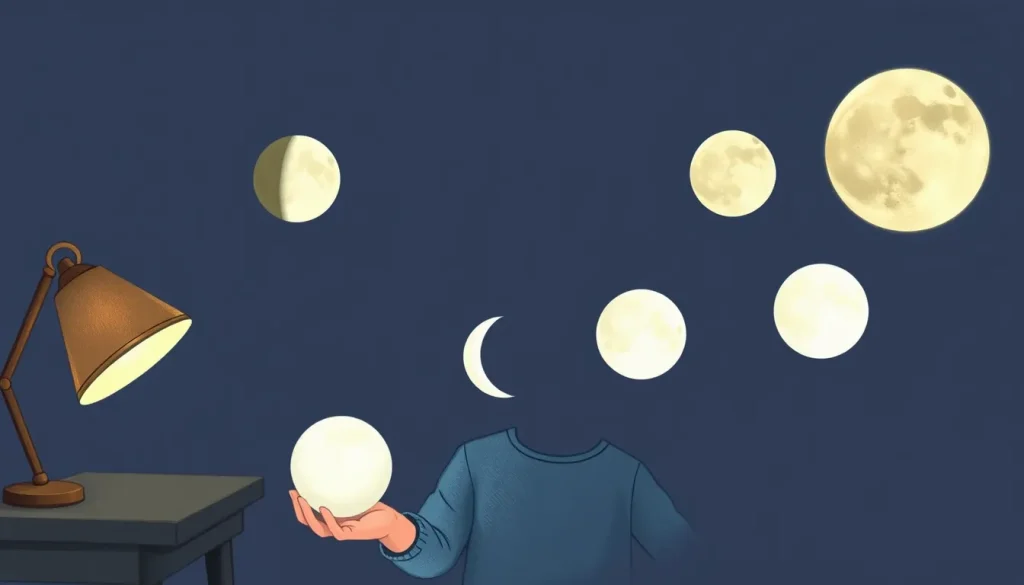
Seeing the Moon change from a thin crescent to a bright full disk can feel like magic. In reality it is a predictable result of the Moon’s orbit around Earth and the way sunlight shines on the half of the Moon that faces the Sun. A lamp‑and‑ball model makes this invisible geometry visible on a kitchen table, turning an abstract concept into a concrete observation.
Overview
This activity is a demonstration designed for ages 6‑14. It uses everyday items— a desk lamp (or flashlight) and a paper ball—to replicate a month‑long cycle of lunar phases in a few minutes. The goal is to let learners watch the illuminated portion of the ball grow and shrink as they turn it, then connect that visual change to the real Moon’s behavior.
Before You Begin
- Workspace: Choose a dim room or turn off the lights so the lamp’s beam is the dominant light source.
- Adult supervision: Required for handling the lamp, especially if it uses a plug. Younger children should hold the ball while the adult steadies the lamp.
- Safety: Keep the lamp tip away from the ball’s surface to avoid overheating. Do not look directly into the lamp if it is a bright flashlight.
Materials
- One desk lamp or flashlight (a bright, steady light source).
- One small paper ball, about 2–3 inches in diameter. You can make it by crumpling a sheet of paper into a tight sphere.
- Optional: A piece of cardboard (≈12 × 12 in) to serve as a stand for the lamp, keeping it at a consistent height.
- Toothpicks or a short skewer (optional) to attach the ball to a finger for easier turning.
Steps
- Set up the lamp on a table so that its beam points upward at about shoulder height.
- Place the paper ball in one hand (or attach it to a toothpick held between thumb and forefinger).
- Stand with the lamp behind you so the light shines on the ball from the side, mimicking the Sun’s illumination of the real Moon.
- Start with the ball positioned so that the lit half faces away from you — this represents new Moon (the Moon is dark from Earth’s perspective).
- Turn the ball slowly in a clockwise direction, keeping the same distance from the lamp. Observe how the bright portion grows.
- Continue turning until the entire illuminated side faces you; this is the full Moon stage.
- Keep turning the ball past full Moon until the illuminated portion shrinks again, completing the cycle back to new Moon.
- Repeat the motion a second time, noting any differences you see when the ball is turned faster or slower.
What to Observe
Use a simple observation sheet (draw a 4‑column table) and record:
- Position in the turn: Approximate angle (0° for new Moon, 90° for first quarter, 180° for full Moon, 270° for last quarter).
- Visible shape: Sketch the illuminated portion (crescent, half‑moon, gibbous, full).
- Brightness: Note whether the lit area looks “thin,” “half,” or “full.”
These observations will match the sequence shown in most textbook diagrams of lunar phases.
The Science Explained
Only one half of the Moon is ever illuminated because sunlight travels in straight lines. As the Moon travels around Earth, the angle between the Sun, Moon, and an observer on Earth changes. When the Moon is between Earth and the Sun, the Sun‑lit side faces away from us and we see a new Moon. As the Moon moves 90° along its orbit, half of the illuminated side becomes visible – the first quarter. When the Moon is on the opposite side of Earth from the Sun, the entire lit half faces us, producing a full Moon. Continuing around the orbit, the illuminated portion shrinks again, giving the last quarter and then back to new Moon. This geometry is illustrated in the lamp‑and‑ball model: the lamp stands in for the Sun, the ball for the Moon, and your eye for an observer on Earth. The model shows that the phases are not caused by Earth’s shadow (a common misconception) but by the changing view of the Sun‑lit half of the Moon [1]. The OpenStax Astronomy text confirms that “the Moon does not shine on its own; it reflects sunlight, and the amount we see depends on its position in orbit” [3].
Model Limitations
While the lamp‑and‑ball model captures the essential geometry, it simplifies several real‑world details:
- Scale: The actual Sun‑Moon‑Earth distances are millions of kilometers; the model compresses them to a few feet, so the angles are exaggerated.
- Eclipse representation: When the ball passes directly behind a small object (e.g., a hand) that casts a shadow onto it at full Moon, the model can mimic a lunar eclipse, but the timing and size of Earth’s shadow are not accurate.
- Brightness variation: The real Moon appears slightly dimmer at crescent phases because of the Earth’s atmosphere scattering light; the model’s lamp provides uniform illumination.
- Orbital tilt: The Moon’s orbit is inclined about 5° to Earth’s orbital plane, causing the exact timing of phases to shift slightly each month. The model assumes a perfectly coplanar orbit.
Understanding these limits helps learners see what a model can and cannot explain.
Try Another Version
Once the basic demonstration is mastered, extend it:
- Use a globe: Replace the paper ball with a small globe that shows continents. Discuss why the same phases appear regardless of surface features.
- Measure angles: Mark a protractor on the table and record the exact angle of the ball when each phase appears. Compare the measured angles to the ideal 0°, 90°, 180°, and 270° positions.
- Earth’s view from the Moon: Switch positions—hold the lamp and ball while you become the “Earth” looking at a bright “Sun.” Observe that from the Moon, Earth would show phases opposite to those of the Moon.
Cleanup and Storage
Turn off the lamp and store it safely. The paper ball can be reused; if it becomes flattened, simply make a new one from scrap paper. Dispose of any torn paper in the recycling bin.
Related terms
- Lunar phase
- The shape of the illuminated portion of the Moon as seen from Earth, which changes over a 29.5‑day cycle.
- Illumination
- The part of the Moon that is lit by sunlight; only half of the Moon is illuminated at any moment.
- Orbit
- The curved path a body follows around another body due to gravity; the Moon orbits Earth roughly every 27.3 days.
Sources & references
- Phases of the Moon | NSTA – https://www.nsta.org/phases-moon
- 4.5 Phases and Motions of the Moon – OpenStax – https://openstax.org/books/astronomy-2e/pages/4-5-phases-and-motions-of-the-moon
- Moon Phases at Home: The Lamp-and-Ball Model – ToyBox Science – https://toyboxscience.com/experiments/moon-phase-model