Overview
This activity investigates a basic question that links everyday play with real planetary science: Does the height from which an object is dropped change the width of the crater it makes in damp sand? The experiment is safe, inexpensive, and can be carried out on a kitchen table or classroom bench. It introduces concepts such as kinetic energy, impact force, and scaling laws while giving children a tangible result they can measure and graph.
Before You Begin
- Choose a flat, stable surface where sand spillage will not cause a mess (a kitchen counter, a large tray, or a cardboard box works well).
- Gather all materials before the first drop – changing set‑up mid‑experiment can add unwanted variables.
- Plan for at least 15‑20 minutes of active work plus a few minutes for cleanup.
- Adult supervision is recommended for children under 10, especially when handling the ruler or moving the tray.
Materials
- Fine sand (play sand or sandbox sand)
- Water – enough to make the sand slightly damp but not soggy
- Two sizes of glass or steel marbles (e.g., 1 cm diameter and 2 cm diameter)
- Cardboard tray or shallow box (about 30 cm × 30 cm × 10 cm deep)
- Ruler or measuring tape (minimum 1 m length)
- Meter‑stick or a piece of string marked in centimetres for measuring drop height
- Marker or pencil for noting measurements
- Notebook or printed data table (see below)
- Optional: a small funnel to add water evenly
Variables, Controls, and Repeated Trials
Testable question: How does the drop height (independent variable) affect the crater width (dependent variable) when the same marble is used?
Controlled variables:
- Marble size and material (use the same marble for a set of trials)
- Sand moisture level – add the same amount of water each time and stir to a uniform consistency
- Drop location – always drop the marble onto the centre of the sand surface
- Ambient conditions – perform all drops in the same room to keep temperature and humidity constant
Perform at least three trials for each height to capture natural variation. More trials improve confidence in the average values.
Procedure (Steps)
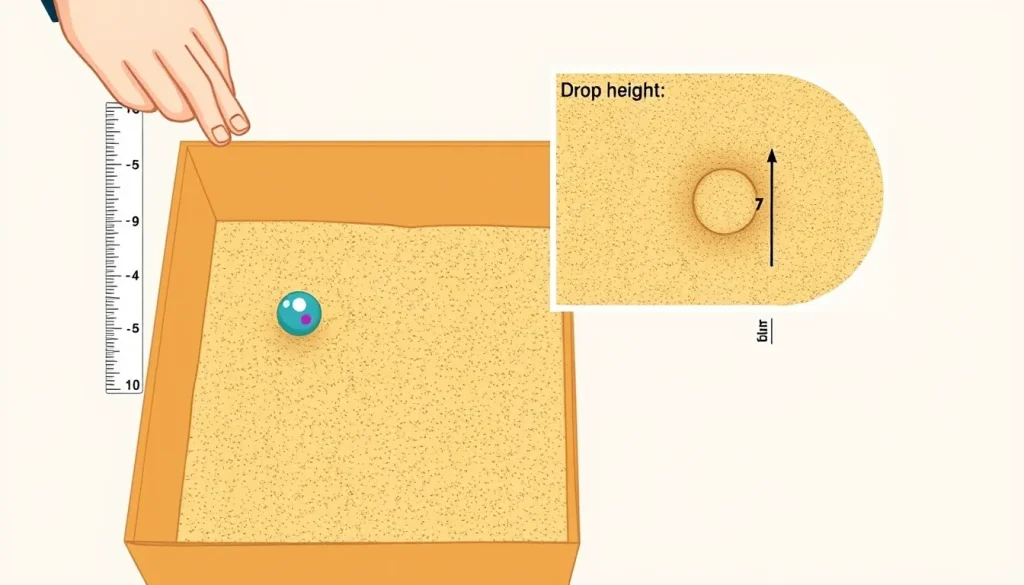
- Fill the cardboard tray with sand to a depth of about 5 cm.
- Lightly sprinkle water over the sand while stirring with a hand or small shovel until the sand feels damp but holds together when squeezed. Record the amount of water used (e.g., 30 ml per 500 g sand) so you can repeat the same moisture level later.
- Level the surface gently with a flat board or the back of a ruler.
- Place the ruler or a marked string vertically at the edge of the tray; this will be used to set the drop height measured from the sand surface.
- Select the marble you will test (start with the smaller marble). Hold the marble at the chosen height (e.g., 0.5 m), then release it straight down so it lands on the centre of the sand.
- Allow the sand to settle for a few seconds, then use the ruler to measure the crater’s maximum width (the longest distance across the rim) and record it in the data table.
- Return the marble to the side, smooth the sand back to a level surface, and repeat steps 5‑7 for the same height two more times.
- Increase the drop height (e.g., to 1.0 m) and repeat the full set of three trials.
- When the desired range of heights is completed (recommended heights: 0.5 m, 1.0 m, 1.5 m), switch to the second marble size and repeat the entire sequence.
- After all measurements are taken, clean the work area (see Cleanup section).
What to Observe or Measure
For each trial record:
- Drop height (cm)
- Marble size (diameter in cm)
- Crater width (cm) – measured across the widest part of the rim
- Any noticeable differences in crater shape (e.g., circular vs. slightly elliptical)
Data Table
| Trial | Marble Diameter (cm) | Drop Height (cm) | Crater Width (cm) |
|---|---|---|---|
| 1 | |||
| 2 | |||
| 3 | |||
| 4 | |||
| 5 | |||
| 6 |
Graphing Your Results
Plot a scatter graph with drop height (cm) on the horizontal axis and average crater width (cm) on the vertical axis for each marble size. Connect the points for each marble with a different colour line. The shape of the trend line gives a visual clue about the relationship – a gentle upward slope suggests that higher drops make wider craters, while a flat line would indicate no effect.
The Science Explained
When a marble is released, it accelerates under gravity and gains kinetic energy (KE) equal to ½ m v². The impact speed v is proportional to the square root of the drop height (v ≈ √(2 g H)), so the kinetic energy at impact scales with the height H:
KE ∝ m · H
Research on low‑speed impacts into granular media (dry sand) has shown that the crater diameter Dc follows a quarter‑power law with the impact energy: Dc ∼ (ρb Db³ H)¹⁄⁴ where ρb is the ball density and Db its diameter [3]. Although our sand is damp (adding cohesion) and our marbles are small, the same general trend—crater width increasing with impact energy—still holds, which means higher drops should produce larger widths, but the increase is not linear.
Because the exponent is only ¼, a doubling of drop height results in only about a 19 % increase in crater width (2¹⁄⁴ ≈ 1.19). This explains why children often see only a modest change when they double the height. Understanding this scaling helps link a classroom activity to real planetary cratering, where meteorite velocity (related to height in a simplified model) dramatically influences crater size.
Troubleshooting
- Crater width does not change with height: Check that the sand is evenly damp. Very dry sand behaves like a loose granular medium and may produce irregular craters; overly wet sand can become too cohesive, suppressing crater growth.
- Measurements are inconsistent: Ensure the ruler is placed perpendicular to the sand surface each time. Use the same person to read the width, or take a photo and measure later with a ruler on the screen.
- Marble bounces out of the sand: Reduce the drop height or increase sand depth. A deeper sand layer gives the ball more material to stop it.
- Sand spills over the tray: Use a larger cardboard tray or place the tray on a sheet of newspaper.
Try Another Version
After completing the height‑width investigation, extend the experiment by changing a different variable:
- Marble size or material: Use a heavier steel ball or a lighter plastic bead to see how density influences crater size.
- Sand moisture level: Add more water to make the sand wetter, or let it dry partially, and observe the effect on both width and depth.
- Impact angle: Instead of dropping straight down, roll the marble down a short ramp so it hits the sand at an angle, then record the resulting crater shape.
Cleanup and Disposal
Gather the sand in a resealable bag for future use or discard in the garden if it is clean. Wipe the tray with a damp cloth, let it dry, and store it flat. Rinse the ruler and any reusable tools. Water used in the experiment can be poured down the sink.
Next Steps
Use the data you have collected to write a short report that includes:
- A description of the question, method, and variables.
- Tables of raw measurements and calculated averages.
- The graph of height versus crater width.
- An interpretation that connects the observed trend to the energy‑scaling law discussed above.
Sharing the report with classmates or posting it on a family science blog reinforces scientific communication skills and shows how a simple tabletop experiment mirrors the physics of real meteor impacts.
Sources & references
- https://journals.aps.org/prl/abstract/10.1103/PhysRevLett.90.194301
- https://arbs.nzcer.org.nz/resources/investigating-crater-impact
- https://pmt.physicsandmathstutor.com/download/Science/GCSE/Past-Papers/WJEC-Wales/Unit-7/June2025IN-Unit7WJECScienceGCSE.pdf
- https://physlab.org/wp-content/uploads/2016/03/craters_in_sand_2020_v1.pdf