Overview
Every day a household produces water that carries food scraps, soap, and tiny amounts of nutrients. In many parts of the world this domestic wastewater is reused for irrigation because it contains nitrogen, phosphorus, and potassium—elements plants need to grow. At the same time, the water can also contain salts, pathogens, or chemicals that may harm seedlings. By testing how different concentrations of household wastewater affect seed germination, children can see science in action, practice the scientific method, and learn why water quality matters for agriculture.
Before You Begin
- Safety first. Wear gloves when handling wastewater and wash hands thoroughly afterward. Keep the experiment away from food preparation areas.
- Collecting wastewater. Use water that has run through your sink or washing machine (no bleach or strong chemicals). Let it sit for a few minutes to allow large particles to settle, then filter through a clean coffee filter or cheesecloth.
- Choose a seed species. Easy‑to‑grow beans (e.g., mung bean), peas, or radish seeds work well for ages 6‑14 because they germinate quickly and produce visible seedlings within a week.
- Set up a workspace. A kitchen counter or a table with newspaper or a disposable tray makes cleanup simple. Have a ruler, a permanent marker, and a notebook ready for recording data.
Materials
- Household wastewater (collected as described above)
- Distilled or tap water (for the control group)
- Measuring cup or graduated cylinder (100 ml capacity)
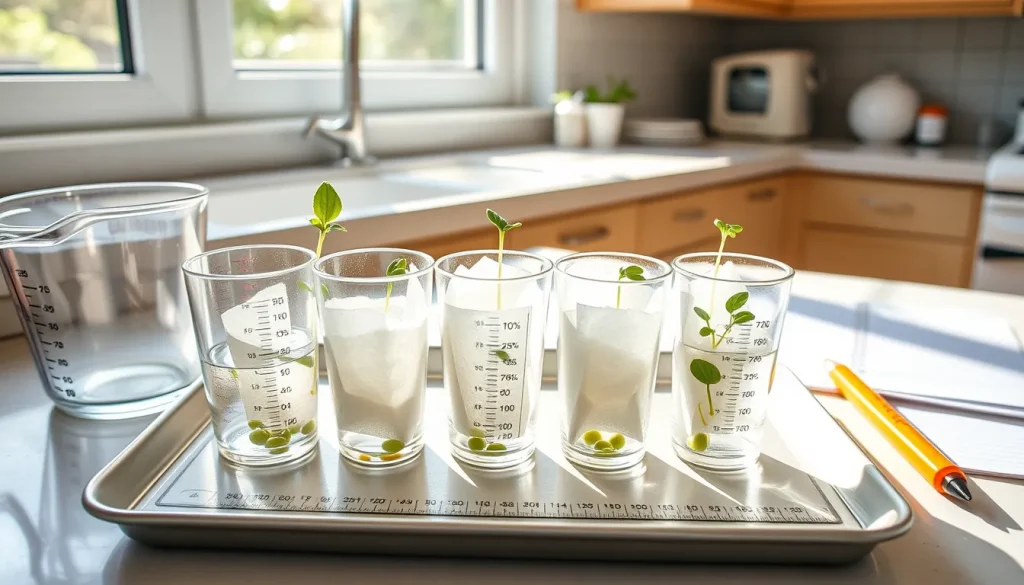
- Five clear plastic cups or small containers (same size)
- Filter paper or paper towels (cut to fit the cup bottoms)
- Seed packets (e.g., mung beans, peas, radish)
- Permanent marker for labeling
- Ruler (cm)
- Notebook or data sheet (printable table provided below)
- Optional: pH test strips to record acidity of each solution
All items are common household supplies; no specialized laboratory equipment is required.
Testable Question
How does the concentration of household wastewater affect the percentage of seeds that germinate within five days?
Hypothesis (Example)
Because wastewater contains nutrients, a low concentration (e.g., 25 % wastewater mixed with 75 % fresh water) will increase germination compared with pure fresh water. At higher concentrations (≥75 %) the excess salts and possible contaminants will reduce germination.
Variables and Controls
- Independent variable: Percentage of wastewater in the irrigation solution (0 %, 25 %, 50 %, 75 %, 100 %).
- Dependent variable: Germination rate (number of seeds that sprout) and seedling vigor (average shoot length after five days).
- Controlled variables: Seed species, seed quantity per cup, temperature (room temperature 20‑22 °C), light exposure (same distance from a windowsill or grow light), and amount of water added each day (e.g., 20 ml).
- Control group: Seeds watered with only distilled or tap water (0 % wastewater).
Procedure (Step‑by‑Step)
- Label the five cups as 0 %, 25 %, 50 %, 75 %, and 100 %.
- Place a piece of filter paper in each cup and moisten it with 20 ml of the appropriate solution:
- 0 % – 20 ml distilled/tap water.
- 25 % – 5 ml wastewater + 15 ml distilled water.
- 50 % – 10 ml wastewater + 10 ml distilled water.
- 75 % – 15 ml wastewater + 5 ml distilled water.
- 100 % – 20 ml wastewater.
- Place the same number of seeds (e.g., 10) on the surface of the damp filter paper in each cup. Space them evenly so roots do not tangle.
- Cover each cup loosely with a piece of clear plastic wrap to retain humidity, then poke a few small holes for air exchange.
- Put the cups in a location that receives consistent indirect light. Record the start date and time.
- Each day for five days, add 5 ml of the same solution to each cup to keep the paper moist. Note any visible changes (e.g., mold, discoloration).
- At the end of day five, count how many seeds have produced a visible shoot of at least 2 mm. Measure the length of each seedling with a ruler and record the average length for each cup.
Repeated Trials
To account for natural variation, repeat the entire experiment on at least three separate occasions (different days). Use fresh seeds and freshly prepared solutions each time. Averaging the results across trials improves reliability.
What to Observe or Measure
- Germination count: Number of seeds that sprout (≥2 mm shoot) per cup.
- Germination percentage: (germinated seeds ÷ total seeds) × 100.
- Seedling vigor index: Germination % × average shoot length (cm). This combines quantity and quality of growth.
- Optional observations: color of cotyledons, presence of mold, water clarity.
Data Table
| Trial | Concentration | Seeds Planted | Seeds Germinated | Germination % | Average Shoot Length (cm) | Vigor Index |
|---|---|---|---|---|---|---|
| 1 | 0 % | |||||
| 1 | 25 % | |||||
| 1 | 50 % | |||||
| 1 | 75 % | |||||
| 1 | 100 % |
Graphing Your Results
A simple bar graph works well. Plot concentration on the horizontal axis and germination percentage (or vigor index) on the vertical axis. Use a different colour for each trial or combine trials by averaging and show error bars representing the range.
The Science Explained
Plants require water, carbon dioxide, light, and mineral nutrients to grow. Household wastewater often contains organic matter that releases nitrogen (as ammonia or nitrate), phosphorus, and potassium—nutrients that can boost seedling growth. However, the same water may also carry:
- High salt concentrations. Excess sodium or chloride can draw water out of seed cells, slowing germination.
- Pathogenic microbes. Some bacteria or fungi can attack vulnerable seedlings.
- Chemical residues. Detergents, bleach, or personal‑care products may be phytotoxic.
Research supports these mixed effects. Sinha and Paul (2013) found that domestic sewage water significantly reduced germination and vigor of chickpea (Cicer arietinum) and pea (Pisum sativum) compared with distilled water, especially at higher concentrations【1】. A South‑African study showed that untreated effluent lowered germination of tomato, carrot, onion, and lettuce, while treated effluent (with nutrients retained but toxic compounds removed) actually increased germination percentages, sometimes exceeding 150 % of the control【2】. Similar experiments with rice and wheat reported statistically significant drops in germination rate and seedling growth as sewage concentration increased【3】, and a Malaysian dissertation observed that low‑level municipal wastewater (≤25 %) could be tolerated, but 100 % wastewater severely inhibited rice seedling development【4】.
These findings suggest a threshold: low to moderate wastewater concentrations may act like a weak fertilizer, whereas high concentrations become harmful. Your experiment will let children discover where that threshold lies for the seed species they chose.
Troubleshooting
- No seeds germinate in any cup. Check that the water temperature is not too cold (<15 °C) and that the seeds are fresh. Try re‑wetting the filter paper with fresh water for a day before adding wastewater.
- Seeds germinate but die quickly. This can indicate excess salts. Dilute the wastewater further (e.g., 10 % instead of 25 %).
- Mold appears on the filter paper. Reduce humidity by opening the plastic cover slightly or using a fresh piece of filter paper each day.
- Measurements vary widely between trials. Ensure that each cup receives the same volume of solution each day and that all cups are placed in the same light and temperature conditions.
Next Steps and Extensions
Once the basic experiment is complete, families can explore further questions:
- How does the pH of wastewater influence germination?
- Do different seed types (e.g., lettuce vs. beans) show different tolerance levels?
- What happens if the wastewater is first filtered through activated charcoal or left to sit for a week?
- Can a simple composting step turn household wastewater into a safer fertilizer?
These extensions deepen understanding of water quality, nutrient cycling, and sustainable agriculture, and they provide material for a science‑fair poster or a classroom discussion.
FAQ
How do I collect household wastewater safely?
Collect water that has run through your sink or washing machine, avoid any water that contains bleach or strong detergents, let it settle for a few minutes, and filter it through a clean coffee filter or cheesecloth before use.
What seed types work best for this experiment?
Fast‑germinating beans such as mung beans, peas, or radish seeds are ideal for ages 6‑14 because they sprout within a week and produce visible seedlings for measurement.
How many trials should I run for reliable results?
Run the experiment at least three separate times on different days, using fresh seeds and freshly prepared solutions each time, then average the data to improve reliability.
Can I use bleach‑free dish soap in the wastewater?
No. Even bleach‑free detergents can contain chemicals that are phytotoxic. Use only plain water from sinks or washing machines that has no added cleaning agents.
How do I calculate the seedling vigor index?
Multiply the germination percentage by the average shoot length (in centimeters) for each concentration: Vigor Index = Germination % × Average Shoot Length (cm).
Related terms
- Germination
- The process by which a seed resumes growth and develops a shoot after a period of dormancy.
- Vigor index
- A combined measure of germination percentage and seedling growth (usually length), used to assess seed quality.
- Phytotoxicity
- The quality of a substance that is harmful to plants, often causing reduced germination or stunted growth.
Sources & references
- Sinha, S. N., & Paul, D. (2013). Impact of sewage water on seed germination and vigour index of Cicer arietinum L. and Pisum sativum L. International Journal of Food, Agriculture and Veterinary Sciences. https://www.cibtech.org/J-FOOD-AGRI-VETERINARY-SCIENCES/PUBLICATIONS/2013/Vol_3_No_3/JFAV-03-003-SINHA-IMPACT-Sativum.pdf
- Mthembu, S., et al. (2015). Evaluation of phytotoxicity effect on selected crops using treated and untreated wastewater from different configurative domestic wastewater plants. Environmental Technology. https://doi.org/10.1080/09593330.2015.1132776
- Sinha, S. N., & Paul, D. (2012). Impact of domestic waste water on seed germination and physiological parameters of rice and wheat. International Journal of Research. http://arpapress.com/Volumes/Vol12Issue2/IJRRAS_12_2_15.pdf
- Gassama, U. M. (2015). Effects of different concentrations of municipal wastewater on seed germination and seedling performance of three rice varieties. Universiti Putra Malaysia Dissertation. http://psasir.upm.edu.my/id/eprint/67756/1/FP201590IR.pdf