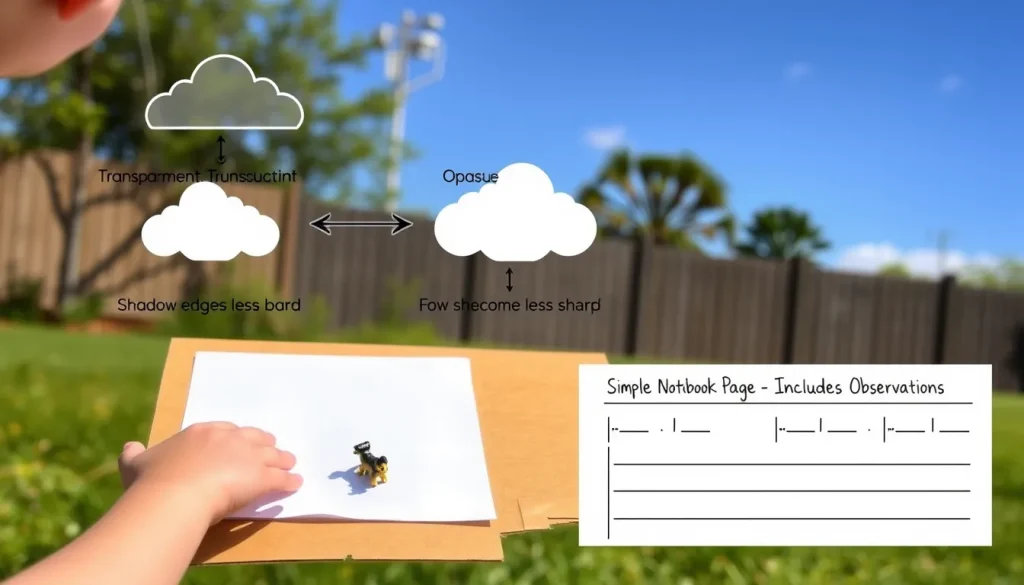
Shadows are the dark shapes made when an object blocks sunlight. On a clear day the edges are crisp; on a cloudy day they become fuzzy or disappear. This activity lets children observe and record how the visual opacity of clouds—transparent, translucent, or opaque—changes shadow sharpness. It requires only paper, cardboard, a small object, and a notebook, making it perfect for home, homeschool, or classroom use.
Before You Begin
- Choose a safe outdoor spot. Pick a flat, light‑colored surface (a driveway, a sidewalk, or a sheet of white cardboard) where the sun shines directly for part of the day.
- Pick a consistent time window. To isolate cloud effects, try to observe within a two‑hour window when the sun’s height in the sky changes only slightly.
- Safety first. Never look directly at the Sun while positioning objects; use shadows or indirect sight.
- Gather a cloud‑opacity reference. Print the GLOBE visual opacity chart or the MetLink cloud colour chart (both linked in the references) so you can classify clouds each time you record a shadow.
Materials
- 1 sheet of white paper (A4 or letter size) – serves as the observation surface.
- 1 piece of thin cardboard (about 30 × 30 cm) – provides a stable, flat platform.
- A small, easy‑to‑see object (toy figurine, cup, or bottle) – will cast the shadow.
- Notebook or worksheet for recording observations.
- Pen or pencil.
- Optional: a smartphone with a free light‑meter app (as suggested by MetLink) to record ambient light levels.
- Printed cloud‑opacity chart (transparent, translucent, opaque) – see source [1] and [3].
Steps
- Lay the cardboard on the ground, then place the white paper on top.
- Position the chosen object on the paper so it casts a clear shadow onto the surface.
- Note the exact time (e.g., 10:15 am) and date in your notebook.
- Observe the shadow and record:
- Edge quality (crisp, slightly fuzzy, very fuzzy, or invisible).
- Length of the shadow (optional, measured with a ruler).
- Darkness rating on a 1‑5 scale (1 = barely visible, 5 = very dark).
- Using the cloud‑opacity chart, classify the clouds overhead as transparent, translucent, or opaque. Follow the criteria from the GLOBE protocol: transparent clouds produce a crisp shadow with clear edges; translucent clouds give a slightly fuzzy edge; opaque clouds make the shadow very fuzzy or invisible [1].
- If you have a light‑meter app, record the ambient light level (lux) for the same moment.
- Wait for the sky to change—clouds often move within 10‑30 minutes. When a noticeable change in cloud type occurs, repeat steps 2‑6.
- Continue this cycle until you have recorded at least three distinct cloud conditions (one of each opacity class) or for a full hour, whichever comes first.
- When finished, compare your notes to see how shadow sharpness varied with cloud opacity.
What to Observe or Measure
The primary observation is shadow edge quality. Use these descriptive categories:
- Sharp (crisp) – edges are well‑defined, easy to trace.
- Soft (slightly fuzzy) – edges begin to blur, but the outline is still recognizable.
- Very fuzzy – edges are blurry, the shape is hard to tell.
- Invisible – no discernible shadow.
Optional quantitative measures:
- Shadow length (centimetres) using a ruler.
- Ambient light level (lux) from a smartphone app.
- Darkness rating (1‑5) as a subjective intensity gauge.
Observation Journal
| Date | Time | Cloud Opacity | Shadow Edge | Shadow Length (cm) | Darkness (1‑5) | Lux (optional) |
|---|---|---|---|---|---|---|
Fill in a new row each time the cloud condition changes. Consistency—same object, same surface, same viewing angle—makes the patterns clearer.

The Science Explained
Sunlight travels in straight lines until it meets something that can scatter or absorb it. A cloud is a collection of water droplets or ice crystals that can either let light pass (transparent), scatter some of it (translucent), or block most of it (opaque). Scientists talk about a cloud’s visual opacity because it describes how much sunlight reaches the ground, not how thick the cloud is vertically [1].
When the sky is clear or the clouds are transparent, most direct sunlight reaches the surface. The light rays remain parallel, producing a well‑defined shadow with sharp edges. As clouds become translucent, droplets scatter the light in many directions. The sun’s rays are no longer perfectly parallel, so the shadow’s edges soften—this is why you see a “fuzzy” outline on a partly cloudy day. When clouds are opaque, they scatter or absorb almost all direct sunlight; the remaining illumination is diffuse, and shadows become very soft or disappear entirely [2][3].
These effects also depend on the sun’s angle: a low sun creates longer shadows, which can look softer even under clear skies. In this activity we keep the sun’s position roughly constant by observing within a short time window, allowing cloud opacity to be the dominant factor.
Model Limitations
The observation focuses on cloud opacity, but other factors can influence shadow sharpness:
- Surface texture (rough pavement can blur shadows).
- Object shape and height (taller objects cast sharper shadows).
- Atmospheric particles (smog, dust) that also scatter light.
These variables are held constant as much as possible by using the same object, surface, and short observation period.
Try Another Version
To explore the same principle indoors, hang a bright desk lamp and place a sheet of tissue paper, wax paper, or aluminum foil between the lamp and the object. Each material mimics a different cloud opacity (tissue ≈ transparent, wax paper ≈ translucent, foil ≈ opaque). Record how the shadow changes as you swap the material.
Cleanup and Storage
Collect the cardboard, paper, and object. If you used a printed cloud chart, store it flat to avoid creasing. No special disposal is needed.
Next Steps
Discuss the observations with children: Why did the shadow change? How might this affect everyday life (e.g., solar panel efficiency, plant growth)? You can also extend the project by measuring temperature differences under different cloud conditions.
Related terms
- Visual opacity
- A measure of how much sunlight a cloud lets through; higher opacity means less direct light reaches the ground.
- Translucent
- A material that lets light pass but scatters it enough that objects on the other side cannot be seen clearly.
- Diffuse light
- Light that has been scattered in many directions, producing soft shadows or no shadows at all.
Sources & references
- GLOBE Cloud and Contrail Visual Opacity Field Guide – https://www.globe.gov/documents/348614/3d557e09-3bd9-4bc2-8b75-a0288a064cd1
- MetLink – Royal Meteorological Society Cloud Cover and Light Levels – https://www.metlink.org/resource/cloud-cover-and-light-levels/
- SciGirls – Cloud Clues (transparent, translucent, opaque definitions) – https://scool.larc.nasa.gov/pdf/scigirls2015_cloudclues.pdf