Orientation
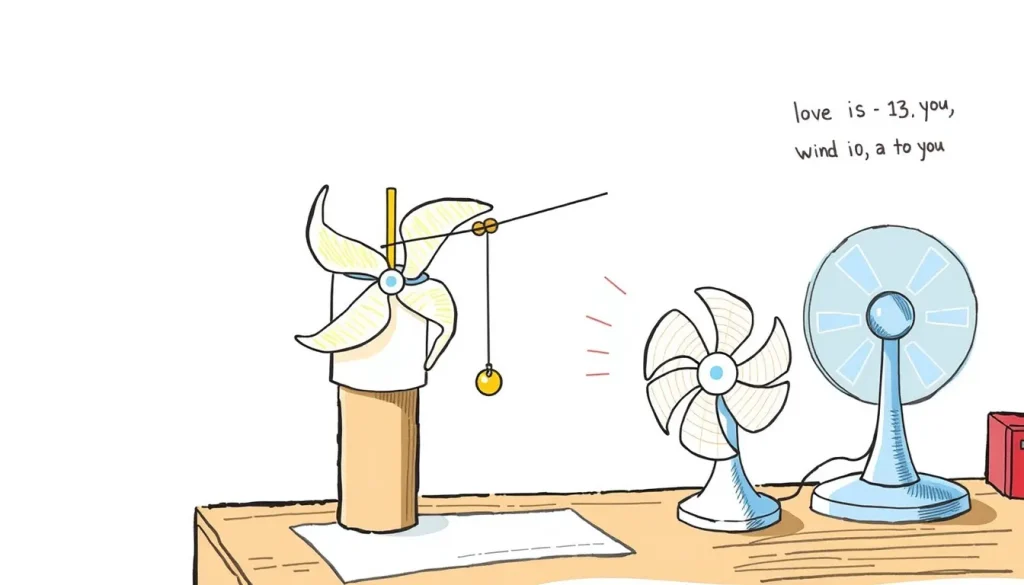
This activity lets children design, build, and test a tiny wind turbine made mostly from paper and cardboard. The goal is to lift a small hanging weight using wind generated by a fan or a hair‑dryer. By changing blade shape, rotor size, or the weight, learners discover how design choices affect the amount of power a turbine can produce.
Before You Begin
- Choose a well‑ventilated workspace where a fan or hair‑dryer can blow safely.
- Adult supervision is required when using scissors, a skewer, or a hair‑dryer.
- Gather all materials before starting so the build can proceed without interruption.
Materials
- 2 small paper cups (one for the rotor blades, one for the base) – the ANU activity uses paper cups as the main structural element.[1]
- 1 cardboard tube (e.g., a paper‑towel roll) – serves as the turbine shaft and support.
- 1 wooden skewer – acts as the axle that the rotor spins on.
- 2 paper straws – to create a simple bearing and reduce friction.
- Masking tape or sticky tape.
- String (30–40 cm long).
- Small weight (paperclip, washer, or a tiny eraser).
- Scissors.
- Hair‑dryer or electric fan (provides the wind source).
Optional upgrades (for later extensions): skateboard bearings, PVC pipe, or a small DC motor to generate electricity (as described in the Exploratorium Power Lifter project).[2]
Design Constraints and Success Criteria
Constraints
- Only the listed materials may be used for the initial build.
- The turbine must fit on a standard desk (no taller than 30 cm).
- The wind source must be a household fan or hair‑dryer set to a low or medium speed.
Success Criteria

- The turbine spins freely when wind is applied.
- It lifts the attached weight at least 2 cm off the table.
- Design improvements increase the lifted height by at least 1 cm compared with the first prototype.
Steps
- Prepare the rotor hub. Cut a small circular opening (about 2 cm diameter) in the bottom of one paper cup. Insert the wooden skewer through the opening so that about 1 cm of skewer protrudes on each side. Secure the skewer with a piece of tape, making sure it can rotate freely.
- Make the blades. Cut the second paper cup into four equal “pie‑slice” sections. Trim each slice into a thin, airfoil‑shaped blade (a gentle curve works best). Attach the blades evenly around the skewer’s protruding end using tape, spacing them roughly 90° apart.
- Build the bearing. Insert a paper straw over each side of the skewer where it exits the cup. The straws act as low‑friction sleeves, allowing the rotor to spin more smoothly.
- Attach the shaft to the support. Slide the cardboard tube over the skewer, positioning the cup‑with‑blades near the top of the tube. Tape the tube to the desk or a sturdy base so the skewer stands upright. Ensure the rotor can spin without touching the desk.
- Connect the weight. Tie one end of the string to the center of the rotor hub (the skewer’s middle). Attach the small weight to the other end of the string. The weight should hang freely when the turbine is at rest.
- Test the turbine. Turn on the fan or hair‑dryer at a steady speed, directing the airflow at the blades from a distance of about 15 cm. Observe whether the rotor spins and whether the weight rises.
- Record observations. Measure the height the weight lifts (in centimeters) and note any wobbling, blade flutter, or friction points. Use the data table below (see “What to Observe or Measure”).
- Iterate. Based on the first results, modify one design element at a time – e.g., reshape blades, add more tape to reduce wobble, or increase the length of the cardboard shaft. Retest and record the new lift height.
What to Observe or Measure
Use the simple table to log each trial. Record the wind source (fan or hair‑dryer), its speed setting (low/medium/high), any design change made, and the lift height achieved.
| Trial | Wind Source & Setting | Design Change | Lift Height (cm) |
|---|---|---|---|
| 1 | Original build | ||
| 2 | |||
| 3 |
The Science Explained
Wind turbines convert the kinetic energy of moving air into rotational kinetic energy. The curved shape of the blades works like an airplane wing: air moves faster over the curved surface, creating lower pressure on one side and higher pressure on the other. This pressure difference produces a lift force that pushes the blade around the axle. When the rotor turns, the axle can do work – in this case, it lifts a weight via the attached string.
Key concepts for learners:
- Aerodynamic lift – the same principle that makes airplanes fly.
- Torque – the twisting force that makes the rotor spin.
- Energy conversion – wind → mechanical rotation → lifting work.
- Friction – the straw bearings reduce friction, allowing more of the wind’s energy to be used for lifting.
Because the model is small, the amount of power generated is tiny. The turbine cannot power a light bulb, but it clearly demonstrates the chain of energy conversion.
Troubleshooting
- Rotor does not spin. Check that the skewer is centered and that the straw bearings are not twisted. Make sure the blades are balanced – remove any tape that makes one blade heavier.
- Weight does not lift. Increase wind speed, straighten the blades to catch more air, or reduce the weight (use a paperclip instead of a washer).
- Excessive wobble. Add a small piece of cardboard behind the rotor hub to act as a stabilizer, or use a longer cardboard tube for a sturdier shaft.
Try Another Version
Once the basic turbine works, challenge learners to explore a new question, such as:
- How does blade length affect lift height?
- What happens if the blades are angled differently (more or less curve)?
- Can a small DC motor attached to the shaft generate enough electricity to light an LED? (This moves the project toward the Exploratorium Power Lifter design that uses bearings and a motor.)
Each variation can be treated as a mini‑experiment within the broader engineering challenge.
Cleanup and Disposal
- Recycle the cardboard tube and paper cups.
- Store the skewer and straws in a small container for future projects.
- Turn off and unplug the fan or hair‑dryer.
Next Steps
Encourage children to document their design journey in a simple engineering notebook: sketch the initial design, note each change, and write a brief reflection on what worked best. This habit reinforces the engineering process and prepares them for future science‑fair projects.
Related terms
- Aerodynamic lift
- A force created when air moves faster over a curved surface, producing lower pressure on that side and causing the surface to be pushed upward.
- Torque
- A twisting force that makes an object rotate around an axis.
- Energy conversion
- The process of changing energy from one form (wind) into another form (mechanical motion).