Overview
This activity lets children act like civil engineers. Using only cardboard, tape, and a few simple tools, they will design, build, and test towers of different heights. The central question is: How does making a tower taller change its ability to stay upright? The challenge combines construction, measurement, and iterative redesign, giving a concrete feel for concepts such as the center of gravity and load distribution.
Before You Begin
- Workspace: Clear a flat surface such as a kitchen table or desk. Protect the area with a sheet of newspaper or a reusable placemat.
- Adult supervision: Children under 10 should be helped with scissors and measuring tools.
- Time estimate: 20–30 minutes of active building, plus 10–15 minutes for testing and redesign.
Materials
- Cardboard sheets (standard corrugated or cereal‑box cardboard) – about 4 × 6 ft total.
- Scissors or a utility cutter.
- Clear packing tape (or masking tape).
- Rubber bands (optional for extra tension).
- Ruler or measuring tape.
- Heavy objects for stability testing (e.g., a small book, a can of beans, or a stack of coins).
- Paper cups or small plastic cups (optional for visual reference of height).
All items are commonly found at home or in a classroom supply closet.
Design Goal and Constraints
Goal: Build the tallest tower that can stand on its own for at least 30 seconds without any external support.
Constraints (to keep the challenge focused):

- Only cardboard, tape, and rubber bands may be used as structural material.
- The base of the tower must be a single rectangular piece of cardboard; you may cut it to any dimensions but it cannot be reinforced with wood or other rigid material.
- Each tower may use no more than 20 cardboard pieces (count every cut‑out or folded segment as one piece).
- No adhesives other than the supplied tape may be applied.
- After construction, the tower must be able to support a 100‑gram weight placed on its top for the 30‑second stability test.
Steps
- Plan your design. Sketch a simple side view showing base width, height, and any interior supports (e.g., triangular braces). Decide how many pieces you will allocate to the base, the shaft, and any bracing.
- Cut the cardboard. Using the ruler, cut the following pieces (example numbers; adjust as you wish):
- Base: 1 piece, 15 cm × 15 cm.
- Vertical sections: 6 pieces, 2 cm × 30 cm (these become the main “walls”).
- Braces: 6 triangular pieces, 2 cm × 15 cm (folded into right‑angle supports).
- Cap: 1 piece, 12 cm × 12 cm (top platform).
- Assemble the base. Tape the four edges of the base together to form a sturdy square. Reinforce the corners with an extra strip of tape.
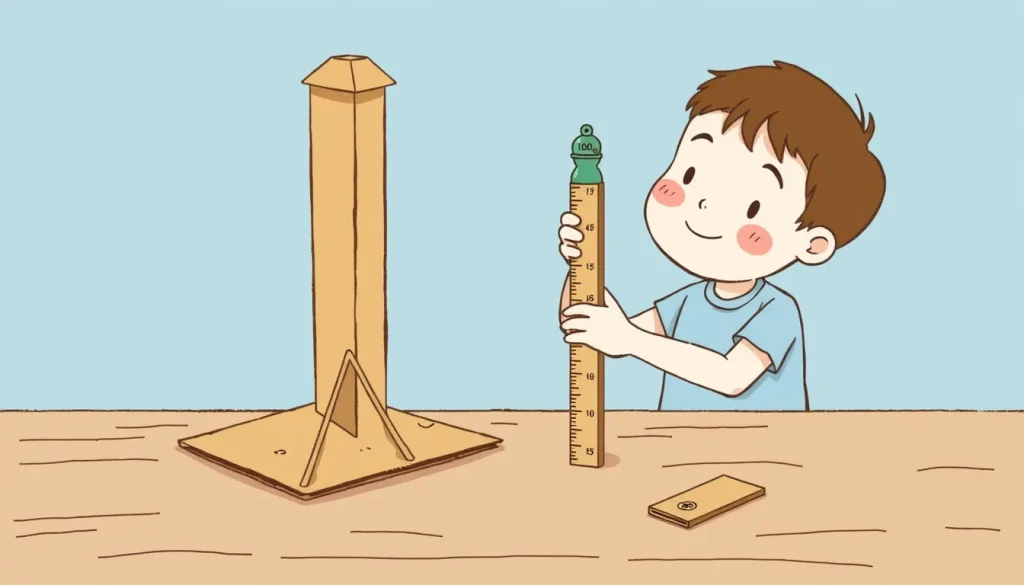
- Build the shaft. Align two vertical sections on opposite sides of the base and tape them upright. Add the remaining two vertical sections on the other sides, forming a rectangular “frame.” Ensure the corners stay square (use a ruler to check 90° angles).
- Insert braces. Tape each triangular brace across the interior of the frame, forming a series of “X” patterns. These braces raise the tower’s shear strength and keep the walls from bowing outward.
- Attach the cap. Tape the cap piece on top of the frame. This provides a flat surface for the weight test.
- Measure the height. Using the ruler, record the distance from the tabletop to the top of the cap (in centimeters). Write the value in your data table.
- Stability test. Place a 100‑g weight (e.g., a small book) gently on the cap. Start a timer. If the tower remains upright for 30 seconds, record “Stable.” If it tips, record the point of failure (e.g., “bent at 45 cm”).
- Iterate. Based on the test, modify one design element (wider base, extra brace, shorter height, etc.) and repeat steps 3‑8. Perform at least three distinct designs.
What to Observe and Measure
| Trial # | Design Notes (base size, braces, height) | Measured Height (cm) | Stability (Yes/No) | Failure Mode (if any) |
|---|---|---|---|---|
| 1 | ||||
| 2 | ||||
| 3 |
In addition to the numeric height, note qualitative observations such as “wiggles when wind from fan is applied” or “base spreads outward.”
The Science Explained
When a tower is built, its ability to stay upright depends on the relationship between its center of gravity (CoG) and its base. The CoG is the point where the tower’s mass balances. A low CoG, close to the ground, makes it harder for the tower to tip over. As height increases, the CoG rises, and the tower becomes more prone to toppling. This principle is described in the “Tower Challenge” lesson on center of gravity and balance, which emphasizes that structures need a low CoG and a wide base to be stable [2](https://www.scholastic.com/koov/pdfs/Lesson_5_KOOV.pdf).
Cardboard towers also illustrate the trade‑off between height and structural stiffness. Tall, thin walls tend to bend or buckle under their own weight, a phenomenon observed in the “Building Block Towers” activity where students notice that “sometimes your tower gets too tall and wobbly” [1](https://www.sciencebuddies.org/stem-activities/block-towers). Adding triangular braces creates a truss‑like structure that distributes forces more evenly, lowering the effective load on any single wall.
In engineering terms, stability can be quantified by the factor of safety – the ratio of the resisting moment (provided by the base width and material strength) to the overturning moment (produced by the tower’s weight acting through its CoG). By measuring how tall a tower can be before it fails, children are exploring this ratio experimentally.
Design Iteration and Improvement
After the first round of testing, discuss with the group which design changes most improved stability. Typical successful strategies include:
- Widening the base: A larger footprint moves the line of action of the weight further inside the base, increasing the resisting moment.
- Adding more braces: Triangular bracing creates a rigid truss that resists bending.
- Shortening the tower: Reducing height lowers the CoG, making the structure inherently more stable.
Encourage children to record each iteration in the table, then plot height (y‑axis) against stability outcome (x‑axis) to visualise the “tipping point.”
Troubleshooting
- Tower falls immediately. Check that the base is square and fully taped. A crooked base shifts the CoG sideways.
- Walls bow outward. Add additional interior braces or use a second layer of tape on each wall for extra stiffness.
- Weight slides off the cap. Ensure the cap is flat and the weight is centered. A small piece of non‑slip fabric can be added under the weight if needed.
- Too many cardboard pieces used. Count each cut piece before you start; discard excess pieces or combine them into larger panels.
Next Steps
Once the basic challenge is mastered, extend the investigation:
- Introduce a gentle fan to simulate wind and observe how the tower reacts.
- Swap cardboard for other everyday materials such as paper cups (as in the “Tallest Cup Tower” activity) to compare material stiffness [4](https://discovere.org/engineering-activities/tallest-cup-tower/).
- Calculate the approximate center of gravity by balancing the tower on a ruler and marking the balance point.
- Document the final design with a drawing and a short paragraph explaining why it performed best.