Orientation
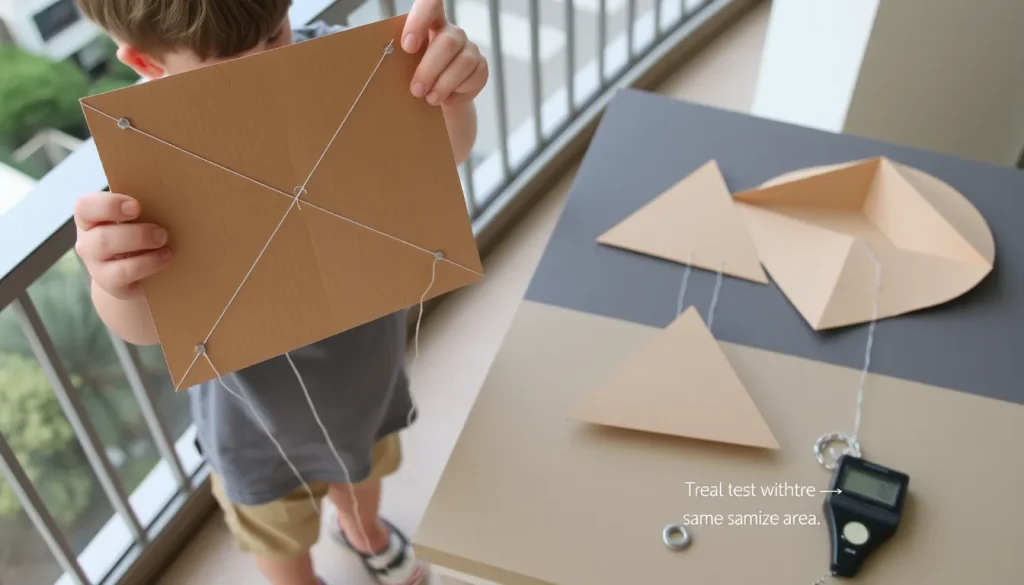
This activity lets children discover how the shape of a parachute influences the time it takes to fall. Using only cardboard and a few household items, they will construct three parachutes that have the same total surface area but different outlines (square, triangle, and circle). By timing each drop, they can see which shape creates the most air resistance and why.
Before You Begin
- Choose a safe indoor drop zone – a stairwell, a balcony, or a clear hallway at least 2 m high.
- Gather an adult to supervise the cut‑and‑tie steps and to help hold the stopwatch.
- Make sure the floor below the drop zone is free of breakable objects.
Materials
- Cardboard sheets (light‑weight corrugated or cereal‑box style) – about 30 cm × 30 cm each.
- Scissors or a craft knife (adult use only).
- String or thin yarn – 4 × 30 cm pieces for each parachute.
- Clear tape or masking tape.
- Small weight (e.g., a washer, metal nut, or a 20 g toy).
- Hole punch or a sharp pencil to make small holes.
- Stopwatch or a phone timer.
- Ruler and pencil for measuring.
Testable Question
How does the shape of a parachute (square, equilateral triangle, or circle) affect its descent time when the surface area is kept constant?
Hypothesis
Because a circular shape distributes air pressure more evenly, the circular parachute will descend more slowly than the square or triangular ones of the same area.
Variables and Controls
| Variable | Type | How It Is Handled |
|---|---|---|
| Shape of parachute | Independent | Three shapes: square, equilateral triangle, circle. |
| Surface area | Control | All three parachutes are cut to the same area (≈ 900 cm²). |
| Weight of payload | Control | Same washer attached to each parachute. |
| String length | Control | Each string is 30 cm; all four strings are equal for every parachute. |
| Drop height | Control | Same height for every trial (measure with a ruler). |
| Air conditions | Control | Conduct all drops in the same room, without fans. |
| Descent time | Dependent | Measured with a stopwatch from release to ground contact. |
Procedure (Steps)
- Draw and cut a 30 cm × 30 cm square from cardboard.
- Using a compass, draw a circle with an area of about 900 cm² (radius ≈ 16.9 cm) and cut it out.
- Draw an equilateral triangle where each side is 33 cm (area = 0.5 × base × height ≈ 900 cm²) and cut it out.
- Mark one hole near each corner of the square, one near each vertex of the triangle, and three equally spaced points around the circle’s edge.
- Thread a 30 cm piece of string through each hole, tie a secure knot, and attach a paperclip to the free end.
- Gather the four paperclips together and slide the weight (washer) onto them, then pull the strings taut so the weight hangs evenly.
- Optional: tape the knot area for extra strength.
- Label each parachute with its shape (Square, Triangle, Circle) using a marker.
- Measure the drop height from the release point to the floor and write it down.
- One at a time, hold a parachute directly above the drop point, release it without pushing, and start the stopwatch.
- Stop the timer when the weight first contacts the floor.
- Record the time in seconds.
- Repeat steps 8‑10 for the same parachute two more times (minimum three trials per shape).
- After completing all trials for one shape, repeat the entire set for the next shape.
What to Observe or Measure
- Descent time (seconds) for each trial.
- Qualitative notes: does the parachute wobble, spin, or stay stable?
Repeated Trials
Perform at least three trials per shape. Multiple trials reveal natural variation and allow you to calculate an average time for each shape.

Data Table
| Shape | Trial 1 | Trial 2 | Trial 3 | Average |
|---|---|---|---|---|
| Square | ||||
| Triangle | ||||
| Circle |
Graphing Your Results
Create a simple column chart:
- X‑axis: Parachute shape (Square, Triangle, Circle).
- Y‑axis: Average descent time (seconds).
- Each column shows the mean time; error bars can represent the range of the three trials.
Seeing which column is tallest makes the answer visual.
The Science Explained
When a parachute falls, the air pushes up on the fabric. This upward force is called drag. Drag grows with two main factors: the speed of the falling object and the amount of surface area that the air can act on. A larger area catches more air, producing more drag and slowing the fall (source [4]).
Shape matters because it changes how the air flows over the parachute. A circular outline allows air to move smoothly around the edge, keeping pressure relatively uniform. Sharp corners (as in a square) can cause turbulent flow, which reduces the effective drag for the same total area. By keeping the area constant and only changing the outline, the experiment isolates the effect of shape on drag.
The lesson plan from the National Museum of the U.S. Air Force encourages exactly this comparison – “construct parachutes of different shapes containing the same surface area, drop them, and measure their time of descent” (source [1]).
Troubleshooting
- Parachute folds or tears. Ensure cuts are clean and avoid sharp corners that could rip the cardboard. Reinforce holes with a tiny piece of tape.
- Unequal string lengths. Measure each string before tying; mismatched lengths cause the parachute to tilt, affecting drag.
- Inconsistent release height. Mark the release point on a wall or use a step ladder to keep the starting height the same.
- Wind drafts. Perform all drops in a still room; close windows and doors.
Next Steps
Try variations such as adding lightweight ribs (folded strips of cardboard) to see how a more three‑dimensional shape changes the result, or use different materials (plastic bags, paper) while keeping shape constant.
Frequently asked questions
Can I use regular printer paper instead of cardboard?
Yes, but the paper must be lightweight and stiff enough to hold its shape. Thinner material may flutter more, which can change the results.
How many trials are needed for reliable data?
Three trials per shape give a simple average and show natural variation. More trials improve confidence but also take more time.
Is it safe to drop the parachutes from a balcony?
Only if the balcony is at least 2 meters high, the floor below is clear, and an adult supervises the drop and the use of scissors.
Related terms
- Drag
- The force of air that opposes the motion of an object moving through it.
- Surface area
- The total area of a shape that comes into contact with the air.
- Control variable
- A factor that is kept the same in all trials so it does not affect the results.
Sources & references
- National Museum of the U.S. Air Force, “Parachutes: Is It Surface Area or Shape?” (PDF), 1 August 2020, https://www.nationalmuseum.af.mil/Portals/7/ParachutesSurfaceAreaorShape.pdf
- Ontario Science Centre, “Parachute Shapes”, https://www.ontariosciencecentre.ca/science-at-home/diy-science-fun/parachute-shapes
- Science World, “Parachute Design and Drop”, https://www.scienceworld.ca/resource/parachute-design-and-drop/