Capillary action is the spontaneous movement of liquid through tiny pores or spaces without external forces. In paper, the network of cellulose fibers creates a porous pathway that can pull water upward. By changing the width of a paper strip, we change the total cross‑sectional area through which the fluid can flow, which in turn influences the rise speed. This experiment lets children observe and measure that effect using everyday household items.
Testable Question
How does the width of a paper strip affect the speed at which water rises by capillary action?
Hypothesis
If a wider strip provides a larger total pore area, then water should rise faster because more fluid can be drawn into the strip at once. Therefore, the hypothesis is that increasing strip width will increase the capillary rise speed.
Materials
- Plain printer or copy paper (any weight, but 80 gsm works well)
- Ruler or measuring tape (centimetre scale)
- Scissors
- Clear plastic cup or small beaker (holds ~200 mL)
- Water at room temperature (about 20 °C)
- Food‑colouring (optional, to make the water visible)
- Stopwatch or a phone timer
- Pencil and a data‑recording sheet (provided below)
- Masking tape (to hold the strip in place)
Before You Begin
Set up a clean, flat workspace. Adults should supervise the use of scissors and ensure the water container does not tip over. If using food‑colouring, add a few drops to the water and stir – this makes the rising front easy to see.
Procedure
- Cut three paper strips of the same length (12 cm) but different widths: 0.5 cm, 1.0 cm, and 2.0 cm. Label each strip with a pencil (e.g., “0.5 cm”).
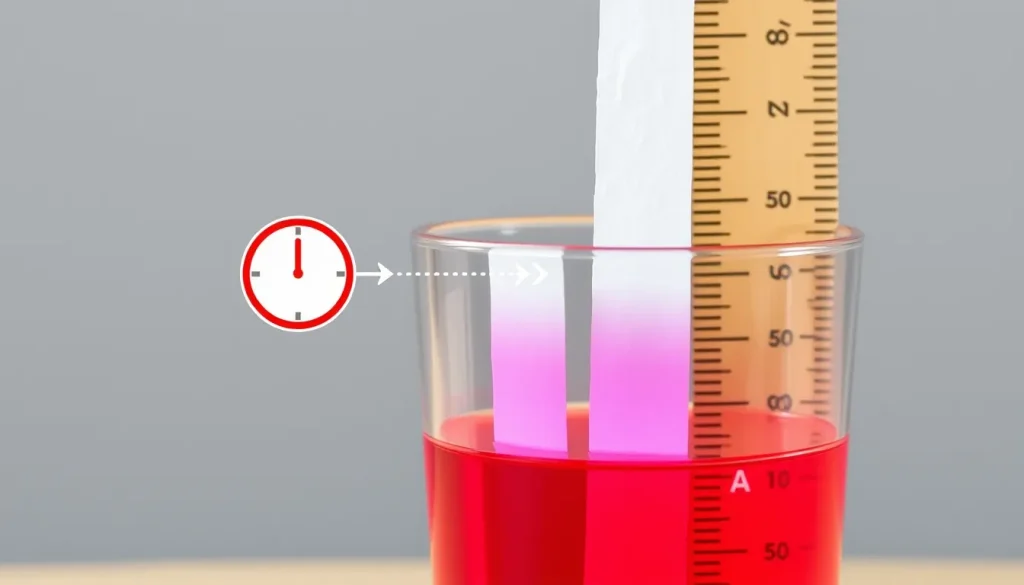
- Place the cup of coloured water on the workspace and set the ruler vertically beside it.
- Using a small piece of masking tape, attach the top edge of the first strip to the ruler so that the strip hangs straight down, just touching the water surface at its lower end. Make sure the strip does not touch the cup sides.
- Start the timer the moment the strip contacts the water.</n
- Observe the coloured water front as it climbs the paper. When the front reaches the 10 cm mark on the ruler, stop the timer and record the elapsed time (seconds). If the front does not reach 10 cm within 2 minutes, stop the timer and record the height reached.
- Remove the strip, dry the ruler, and repeat steps 3–5 for the other two widths. Perform three trials for each width to obtain an average.
- After the experiment, discard the water and recycle the paper strips.
What to Observe or Measure
Record the time (seconds) it takes for the water front to travel 10 cm for each trial. If the front does not reach 10 cm, record the maximum height (centimetres) achieved after 120 seconds. Use the table below to capture your data.
| Strip Width (cm) | Trial | Time to 10 cm (s) or Height at 120 s (cm) |
|---|---|---|
| 0.5 | 1 | |
| 0.5 | 2 | |
| 0.5 | 3 | |
| 1.0 | 1 | |
| 1.0 | 2 | |
| 1.0 | 3 | |
| 2.0 | 1 | |
| 2.0 | 2 | |
| 2.0 | 3 |
Variables and Controls
- Independent variable: Width of the paper strip (0.5 cm, 1.0 cm, 2.0 cm).
- Dependent variable: Capillary rise speed, expressed as time to travel 10 cm (or height after a fixed time).
- Controlled variables: Paper type and length, water temperature, colour, ambient humidity, and the vertical orientation of the strip.
Repeated Trials
Three trials per width reduce random error and let you calculate an average and a simple range. Discuss with the child why repeating measurements helps identify consistency.
Graphing Your Results
Plot strip width on the horizontal axis (x‑axis) and average rise speed on the vertical axis (y‑axis). If you used “time to 10 cm,” a lower time means a faster speed, so you may plot the reciprocal (1/time) to show speed directly. A simple bar graph works well for a beginner audience.
The Science Explained
Capillary rise in porous media follows the Lucas‑Washburn equation, which predicts that the distance a liquid travels is proportional to the square root of time and inversely proportional to the square root of the fluid’s viscosity. In a paper strip, the effective pore radius is related to the total cross‑sectional area of the fibres. Wider strips contain more parallel capillary pathways, effectively increasing the total flow area while the individual pore size stays the same. Research on paper‑based microfluidic devices shows that geometry—especially width—significantly influences fluid velocity because it changes the balance between capillary driving pressure and viscous resistance [1]. Experimental studies on liquid wicking in paper strips confirm that wider channels allow faster wicking due to reduced resistance [3].
Troubleshooting
- Water does not rise at all: The paper may be coated (e.g., glossy magazine paper). Use plain, uncoated printer paper.
- Rise is erratic or stops early: The strip may be bent or not fully vertical. Ensure it is straight and fully immersed at the bottom edge.
- Times are identical for all widths: The strip widths might be too close together relative to the paper’s pore size. Use more distinct widths (e.g., 0.3 cm, 1.5 cm, 3.0 cm).
Common Misconceptions
Many think that a wider strip always makes water climb faster because the surface area is larger. In reality, the speed increase depends on how the additional area reduces viscous resistance; if the strip is too wide, the extra material adds weight and may flatten the capillary pressure gradient, limiting speed. This experiment helps illustrate the balance.
Try Another Version
Replace water with a different liquid (e.g., diluted soap solution) to see how surface tension affects the rise. Or use different paper types—tissue, coffee filter, or cardstock—to explore how pore size influences the result.
Cleanup and Disposal
Pour the coloured water down the sink with plenty of running water. Recycle the paper strips if they are clean; otherwise, discard them in the trash. Wipe the ruler and cup with a damp cloth.
Next Steps
Discuss how the same principles are used in paper‑based diagnostic tests (µPADs) that move tiny fluid samples through patterned channels to detect disease markers. Kids can design their own simple µPAD pattern on a larger sheet of paper and test it with a harmless colour change reaction.
Related terms
- Capillary action
- The movement of liquid through narrow spaces without external forces, driven by surface tension.
- Wicking
- The process by which a porous material draws liquid upward or sideways by capillary forces.
- Viscous resistance
- The frictional force that slows fluid flow through narrow channels.
Sources & references
- Walji, N., & MacDonald, B. D. (2016). Influence of Geometry and Surrounding Conditions on Fluid Flow in Paper-Based Devices. Micromachines, 7(5), 73. https://www.mdpi.com/2072-666X/7/5/73
- Patari, S., & Mahapatra, P. S. (2020). Liquid Wicking in a Paper Strip: An Experimental and Numerical Study. ACS Omega, 5(36), 22931–22939. https://pmc.ncbi.nlm.nih.gov/articles/PMC7495729/