Orientation – Why a Control Group Matters
In any scientific investigation the goal is to find out whether a specific change (the independent variable) actually causes an effect on what you measure (the dependent variable). A control group is a set of identical tests where the independent variable is left unchanged. By comparing the control to the experimental group you can see whether any difference is due to your manipulation or to other, uncontrolled factors. Without a control, it is impossible to claim a fair test.
Before You Begin – Planning the Fair Test
- Choose a clear, testable question. Example: “Does increasing the amount of sunlight affect how quickly beans sprout?”
- Identify variables. Use the three‑variable framework: independent, dependent, and controlled variables (BBC Bitesize).
- Decide on the number of trials. Repeating the experiment at least three times helps confirm that results are consistent (Science Buddies). More trials increase confidence, especially with young learners.
- Gather everyday materials. Pots, beans, paper towels, a sunny windowsill, a dark box, a ruler, and a simple data sheet are enough for the seed‑germination example.
- Set up a workspace. Ensure a flat surface, good lighting for reading, and a safe place for any water or heat sources.
Variables and Controls – The Blueprint of a Fair Test
Write the variables in a table before you start. This makes it easy to see what must stay the same.
| Variable Type | What It Is | How You Will Keep It Consistent |
|---|---|---|
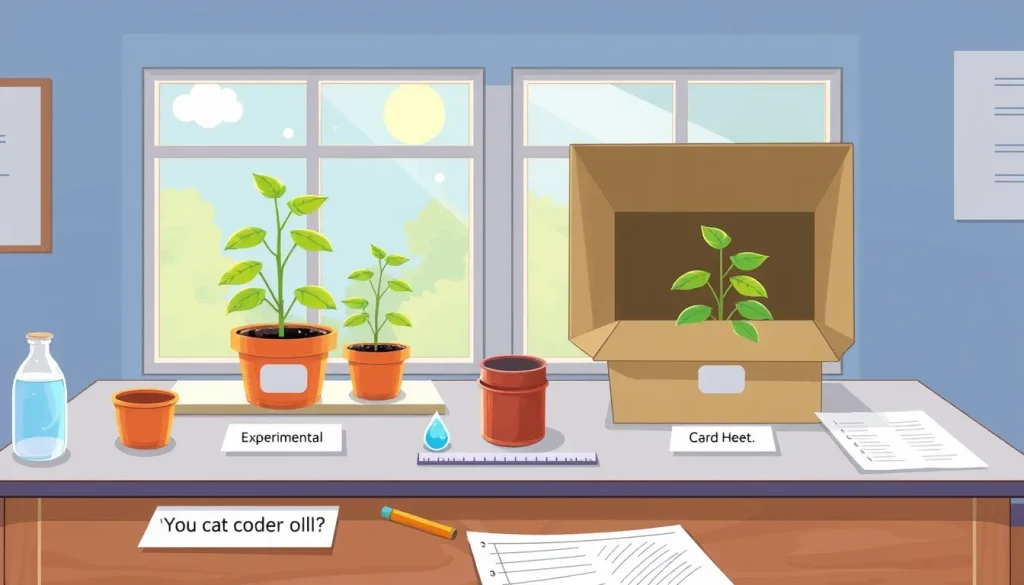
| Independent | Amount of sunlight (full sun vs. darkness) | Place one set of pots on a windowsill, the other in a closed box. |
| Dependent | Time (hours) until the first seed sprouts | Check each pot every 12 hours and record the first sprout. |
| Controlled | Bean variety, pot size, soil amount, water volume, temperature, and observation schedule | Use identical pots, same soil depth, add the same water amount (e.g., 30 ml), and keep the room temperature steady. |
Step‑by‑Step Procedure for Building a Control Group
- Define the experimental and control groups. The experimental group receives the treatment (e.g., sunlight). The control group receives the standard condition (e.g., darkness).
- Prepare duplicate setups. For each trial, set up two identical pots: one for the experimental condition, one for the control. Label them clearly (e.g., “Sunlight A1” and “Control A1”).
- Standardize every other factor. Fill each pot with the same amount of soil, plant the same number of beans at the same depth, and water each with the same volume.
- Apply the independent variable. Place the experimental pots in the sunlight location; keep the control pots in the dark box.
- Start the timer. Record the start time for each trial. Use a simple worksheet to note the date, time, and condition.
- Observe and record. Every 12 hours, look at each pot and note whether any bean has sprouted. Record the exact hour when the first sprout appears.
- Repeat the trial. Conduct at least three independent trials (A, B, C) using fresh beans and fresh soil each time. This satisfies the repeat‑trial recommendation for reliable data (Science Buddies).
- Collect and compare data. After all trials are finished, calculate the average sprouting time for the experimental and control groups. Look for a consistent difference.
What to Observe or Measure
For a control‑group investigation you typically record a quantitative measurement (e.g., time in hours) and a brief qualitative note (e.g., seed health). Use a simple data table like the one below for each trial.
| Trial | Group | Condition | Sprouting Time (hours) | Notes |
|---|---|---|---|---|
| A | 1 | Sunlight | ||
| A | 2 | Control (dark) | ||
| B | 1 | Sunlight | ||
| B | 2 | Control (dark) | ||
| C | 1 | Sunlight | ||
| C | 2 | Control (dark) |
Repeated Trials – Why They Strengthen Your Conclusion
Each trial is an independent run of the whole experiment, from planting to observation. By repeating, you can see whether random variations (e.g., a slightly larger bean) are influencing the result. If all three trials show the sunlight group sprouting faster, the pattern is likely real. If results vary widely, you may need to check for hidden variables or increase the number of trials.
Troubleshooting Common Issues
- Unequal water amount. Use a measuring cup or syringe to give each pot exactly the same volume.
- Temperature drift. Place both groups in the same room; if the sunny windowsill gets warmer, use a fan or move the control box to a spot with similar ambient temperature.
- Mixed up labels. Write labels with permanent marker and double‑check before each observation.
- Inconsistent observation times. Set an alarm or use a classroom timer to check all pots at the same interval.
- Seed variability. Use beans from the same packet and select seeds of similar size.
Common Misconceptions About Control Groups
Next Steps – Extending the Investigation
Once students have mastered a basic control‑group design, they can explore additional questions such as:
- What is the effect of different light colors (red, blue, green) on sprouting?
- Does the amount of water interact with sunlight?
- Can a third group with a moderate amount of light serve as a middle ground?
Each new question will require a fresh control group and careful variable tracking, reinforcing the scientific method skills they have developed.
FAQ
Why is a control group essential for a fair test?
A control group provides a baseline that shows what would happen without the experimental change. By comparing results to this baseline, you can attribute any difference to the independent variable rather than to unrelated factors.
How many trials should I run for a classroom project?
Science Buddies recommends at least three independent trials for most experiments. More trials increase confidence, especially when results vary or when working with younger students.
Can I use the same control group for several different experiments?
Only if the control conditions match the new experiment’s requirements. Otherwise, set up a fresh control that mirrors the new experimental setup exactly, keeping all variables identical except the one you are testing.
Related terms
- Independent variable
- The factor that the experimenter deliberately changes to test its effect.
- Dependent variable
- The outcome measured in the experiment; it may change because of the independent variable.
- Controlled variable
- A condition that is kept the same in all groups to ensure a fair comparison.
- Control group
- A set of tests that do not receive the experimental treatment, serving as a baseline.