Overview
Sound is a vibration that travels through a material (air, water, metal, etc.) and reaches our ears. Two properties of sound that children notice right away are pitch – how high or low a note sounds – and volume – how loud or soft it is. Both depend on the way an object vibrates. The activities below use only everyday objects to let kids see, hear, and measure these effects.
Before You Begin
- Choose a quiet space where the sounds you create can be heard clearly.
- Gather all materials beforehand; many items (spoons, rubber bands, glasses) are already in a typical kitchen or classroom.
- Adult supervision is recommended for cutting straws, handling scissors, and for any activity that involves glass.
- Prepare a simple data sheet (provided later) to record observations.
Materials
| Item | Quantity / Size | Possible Substitutes |
|---|---|---|
| Glass cups or jars | 3–5, same shape | Plastic cups (pitch changes are less dramatic) |
| Water | Enough to fill cups to varying levels | — |
| Metal spoon or wooden stick | 1 | Any thin, rigid stick |
| Two jumbo craft sticks (≈30 cm) | 2 | Two sturdy cardboard strips |
| Regular drinking straw | 1 (cut to pieces) | Thin plastic tube |
| Wide rubber band (≈#64) | 1 | Any thick elastic band |
| Two narrow rubber bands | 2 | Thin hair ties |
| Scissors | 1 pair | — |
| Tape | 1 roll | Glue or a rubber band loop |
Activity 1 – Glass Water Pitch Test
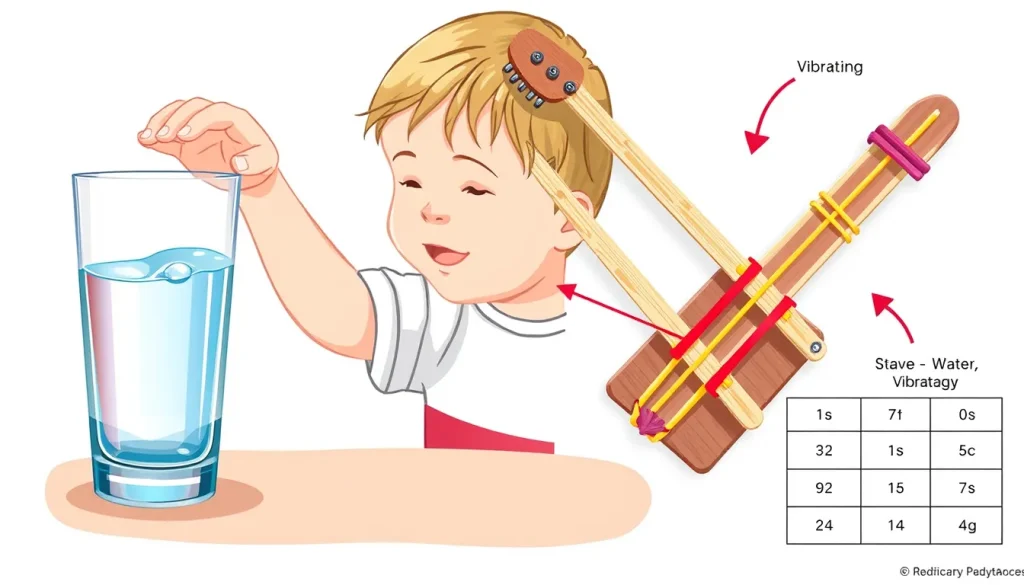
This classic demonstration shows how the amount of water in a glass changes the pitch of the sound produced when the glass is struck.
Steps
- Line up three identical glasses on a flat surface.
- Fill the first glass about one‑quarter full, the second about one‑half full, and the third three‑quarters full.
- Gently tap the rim of each glass with the metal spoon. Listen to the note each glass makes.
- Record which glass produced the highest pitch and which the lowest.
What to Observe
- Pitch change: The glass with the least water should sound highest; the one with the most water should sound lowest.
- Volume: Notice whether the loudness changes noticeably as the water level varies.
Activity 2 – Rubber‑Band Guitar (Sound Sandwich)
The “Sound Sandwich” uses craft sticks, rubber bands, and a straw to make a simple string instrument whose pitch can be altered by changing tension or length of the rubber band.
These steps follow the Exploratorium’s design, which demonstrates how small adjustments raise or lower pitch [3].
Steps
- Stretch the wide rubber band lengthwise over the top of the first craft stick, securing it at both ends.
- Cut two short pieces of straw (≈2.5 cm each). Place one piece under the rubber band about one‑third of the way from the left end of the stick.
- Place the second straw piece on top of the rubber band about one‑third of the way from the right end.
- Lay the second craft stick on top of the first, aligning the ends.
- Wrap a narrow rubber band around the right‑hand end of the sticks to hold them together.
- Pluck the wide rubber band in the middle and listen. The pitch changes if you move the straws closer together (shorter vibrating length) or farther apart (longer vibrating length).
What to Observe
- How the pitch rises when the straws are moved closer together.
- How tightening a narrow rubber band (adding an extra turn) raises the pitch by increasing tension.
- Qualitative differences in volume when you pluck harder or softer.
The Science Explained
When an object vibrates, it pushes and pulls on the surrounding medium, creating compressions and rarefactions that travel as sound waves. The speed of these vibrations determines the frequency – the number of wave cycles per second, measured in hertz (Hz). Higher frequency = higher pitch; lower frequency = lower pitch [4].
In the glass experiment, adding water increases the mass that must be moved. A heavier glass vibrates more slowly, producing a lower frequency and thus a lower pitch. In the rubber‑band guitar, the length of the vibrating portion of the band and the tension both affect frequency. Shortening the length or tightening the band makes the band vibrate faster, raising the pitch.
Volume is related to the amplitude of the vibration – how far the object moves each cycle. Striking a glass harder or plucking a rubber band with more force creates larger amplitude waves, which we hear as louder sounds.
Variables and Controls (for the Glass Pitch Test)
- Independent variable: Amount of water in each glass.
- Dependent variable: Pitch of the sound (you can compare by ear or use a free smartphone tuner app).
- Controlled variables: Glass shape and size, striking tool (same spoon), striking force (tap gently and consistently), ambient temperature.
Data Table (Blank)
| Glass # | Water Level (ml) | Observed Pitch (high/low) | Approx. Frequency (Hz) – optional |
|---|---|---|---|
| 1 | |||
| 2 | |||
| 3 |
Use a free tuner app to record the frequency if you want quantitative data.
Troubleshooting
- No sound from the glass: Ensure the spoon actually contacts the rim; try a firmer tap.
- All glasses sound the same: Verify that water levels differ noticeably; use a measuring cup.
- Rubber band does not vibrate: Make sure the wide band is not too loose; tighten it by pulling the ends slightly before securing.
- Pitch does not change when moving straws: Check that the straws are positioned under and over the band, not merely beside it; the band must rest on the lower straw and be lifted by the upper straw.
Try Another Version
Swap the glass for a metal or plastic container and see whether the material changes the timbre (quality) of the sound. Or, replace the wide rubber band with a different thickness to explore how tension and stiffness affect pitch.
Cleanup and Disposal
Collect all reusable items (rubber bands, craft sticks, straws) for future projects. Wash the glasses and dry them. Dispose of any broken straw pieces in the recycling bin if your community accepts plastic.
Next Steps
After mastering pitch, explore how the length of a vibrating string influences musical notes by building a simple “spaghetti guitar” with uncooked pasta strands. You can also investigate how sound travels through different media by tapping the same glass while it is submerged in water versus in air.
FAQ
Do I need a tuner app to measure pitch?
A tuner app is optional. You can compare pitches by ear, but an app gives a numeric frequency that helps quantify the relationship between water level and pitch.
Can I use plastic cups instead of glass?
Yes, plastic cups work, though the change in pitch is less pronounced because plastic vibrates differently than glass.
Is this activity safe for younger children?
The glass‑water test should be done with adult help, especially when handling glass. The rubber‑band guitar uses only soft materials and is safe for younger kids under supervision.
Related terms
- Frequency
- The number of sound‑wave cycles that pass a point each second, measured in hertz (Hz). Higher frequency means higher pitch.
- Pitch
- The perceived highness or lowness of a sound, determined mainly by its frequency.
- Volume
- How loud or soft a sound is, related to the amplitude (size) of the vibrations.
- Vibration
- A rapid back‑and‑forth motion of an object that creates sound waves in the surrounding medium.
Sources & references
- Simple Instruments | Physics, https://www.physics.uoguelph.ca/simple-instruments
- Sound Sandwich: Sounds & Instrument Science Activity | Exploratorium, https://www.exploratorium.edu/snacks/sound-sandwich
- Lesson Plan: Sound & Pitch, https://www.biophysics.org/Portals/0/BPSAssets/Education/Documents/BPS_LessonPlan_SoundPitch_Mar2025_sm.pdf