This engineering challenge guides families to build a simple solar still from cardboard, using sunlight to evaporate and condense water. The activity demonstrates the basic physics of solar distillation and produces clean water that can be measured and compared.
Before You Begin
- Choose a sunny outdoor spot where the still will receive direct sunlight for at least 4 hours.
- Plan for adult supervision when cutting cardboard or handling sharp tools.
- Gather all materials before starting so the construction can proceed without interruption.
Materials
- Sturdy corrugated cardboard (one large sheet, about 60 cm× 40 cm).
- Transparent plastic sheet or clear freezer bag (minimum 0.1 mm thickness) – acts as the condensing surface.
- Black construction paper or non‑toxic black paint (optional, to increase heat absorption).
- Scissors or a utility knife.
- Clear tape or rubber bands.
- Small cup or shallow bowl (to collect distilled water).
- Container of salty or dirty water (e.g., tap water mixed with 1 tsp salt per litre to simulate seawater).
- Weight such as a small stone or a few coins (to hold the transparent sheet).
All items are commonly found at home or in a school supply cabinet. If clear plastic wrap is unavailable, a clean glass plate can be used as the transparent surface.
Design Constraints and Success Criteria
- Goal: Capture at least 30 ml of distilled water in a 4‑hour period.
- Materials limit: Only cardboard, transparent plastic, tape, and the cup may be used.
- Size limit: The still must fit on a standard tabletop (max 60 cm× 40 cm).
- Leak‑free: No water should escape from the sides of the still.
- Measurement: Record the volume of water collected every hour.
Steps
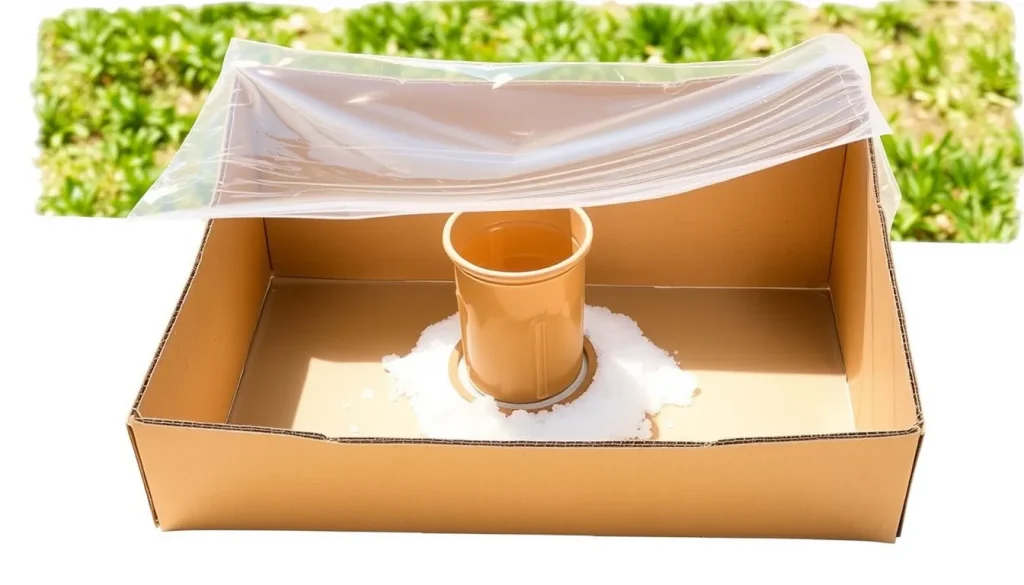
- Build the base. Cut the cardboard to a rectangle (≈60 cm× 40 cm). Fold up the short sides to form a shallow trough about 5 cm high. Tape the folds securely.
- Place the collection cup. Position the small cup in the center of the trough. The cup should sit level; you may cut a shallow depression in the cardboard so the cup rests without tipping.
- Add the source water. Pour the salty water into the trough, filling it to about 2 cm deep. Ensure the water does not spill into the cup.
- Optional heat‑absorbing layer. Line the bottom of the trough with black construction paper or apply a thin coat of black paint. This increases solar absorption (see source [4]).
- Cover with the transparent sheet. Drape the clear plastic over the entire cardboard structure, sealing the edges with tape. The sheet should be tight enough to form a slight slope toward the cup; you can achieve this by placing a small weight (stone) on the sheet directly above the cup so condensed droplets run toward the opening.
- Seal the edges. Tape all gaps around the perimeter so humid air cannot escape.
- Position in sunlight. Place the still on the sunny side of a window or outdoors, angled so the transparent sheet faces the sun directly.
- Observe and record. Every hour, carefully tilt the sheet just enough to let the collected droplets flow into the cup, then return it to its original position. Measure the water volume with a graduated cylinder or kitchen measuring cup.
- Repeat. Continue observations for at least 4 hours, then compare the total volume collected to the success criteria.
What to Observe or Measure
| Time (h) | Volume collected (ml) | Weather notes (clouds, wind) |
|---|---|---|
| 1 | ||
| 2 | ||
| 3 | ||
| 4 | ||
| Total |
Record the temperature of the water in the trough (if a thermometer is available) and note any condensation patterns on the plastic sheet.
The Science Explained
Solar distillation works by using the Sun’s energy to heat water, causing it to evaporate. The vapor rises, leaving salts and non‑volatile impurities behind. When the vapor meets a cooler surface – the transparent sheet – it condenses back into liquid water, which can be collected as pure distilled water. This mimics the natural water cycle: evaporation, condensation, and precipitation [1][2][3]. The black surface underneath the water absorbs more solar radiation, raising the water temperature and increasing the evaporation rate [4]. Because the still is sealed, the only pathway for vapor to leave is through the transparent sheet, ensuring most of the condensed water ends up in the collection cup.
Troubleshooting
- Leakage. If water pools outside the trough, re‑tape the edges and check that the transparent sheet is not torn.
- Low water output. Ensure the transparent sheet is angled toward the cup; a flat sheet allows droplets to run back into the trough.
- No condensation. Cloudy weather reduces solar heating. Try the still on a sunnier day or add a black heat‑absorbing layer.
- Overheating of the plastic. If the plastic becomes very hot and deforms, replace it with a thicker sheet or a glass plate.
Try Another Version
For an extended challenge, experiment with one of the following modifications and record how the water output changes:
- Increase the surface area by using a larger cardboard base.
- Replace the single transparent sheet with a double‑layer (plastic over glass) to improve heat retention.
- Add a reflective foil sheet behind the cardboard to direct additional sunlight onto the water.
- Build a multi‑stage still: the first stage collects water that then feeds a second, smaller still, illustrating cascading condensation.
Cleanup and Disposal
- Dispose of the salty water down the drain.
- Wipe the cardboard and plastic sheet with a damp cloth; recycle the cardboard if possible.
- Store the transparent sheet flat to avoid creasing for future use.
Next Steps
Use the data you collected to calculate the efficiency of your still (volume collected per hour per square metre of solar collector). Compare results with a peer‑built still that uses a different design, or explore how adding a small fan (solar‑powered) changes the condensation rate. The project can also lead into discussions about water scarcity and the role of solar stills in arid regions [4].
Related terms
- Solar distillation
- A process that uses sunlight to evaporate water, leaving impurities behind, and then condenses the vapor to collect pure water.
- Condensation
- The change of water vapor into liquid when it contacts a cooler surface.
- Evaporation
- The transformation of liquid water into vapor when it absorbs heat.
Sources & references
- https://howtofunda.com/solar-distillation-water-purification-working-model-science-project-award-winning-howtofunda/
- https://www.usgs.gov/media/images/how-build-your-own-solar-still
- https://www.energy.gov/eere/education/articles/rain-machine-solar-still
- https://staff.concord.org/btinker/GL/web/water/solar_still.html