Capillary action is the ability of water to climb through narrow spaces against gravity. By using a paper towel as a wick, children can see how water travels from one container to another and how a seed placed on the wet towel begins to absorb that water, mimicking the way seedlings draw moisture from soil.
Before you begin
- Choose a flat, stable surface where the glasses will not tip.
- Adult supervision is recommended for handling scissors and for ensuring the seedling stays moist.
- Gather all materials before starting so the activity can proceed uninterrupted.
Materials
- 2 clear glass or plastic cups (same size)
- Paper towel (plain white, about 30 cm long)
- Water
- Food‑coloring (optional, to make the water visible)
- 1–2 small seeds (e.g., beans, peas, or sunflower seeds) or a pre‑germinated seedling
- Scissors
- Ruler (optional, for measuring water rise)
- Plastic zip‑top bag (optional, to keep the seed moist after the demo)
Steps
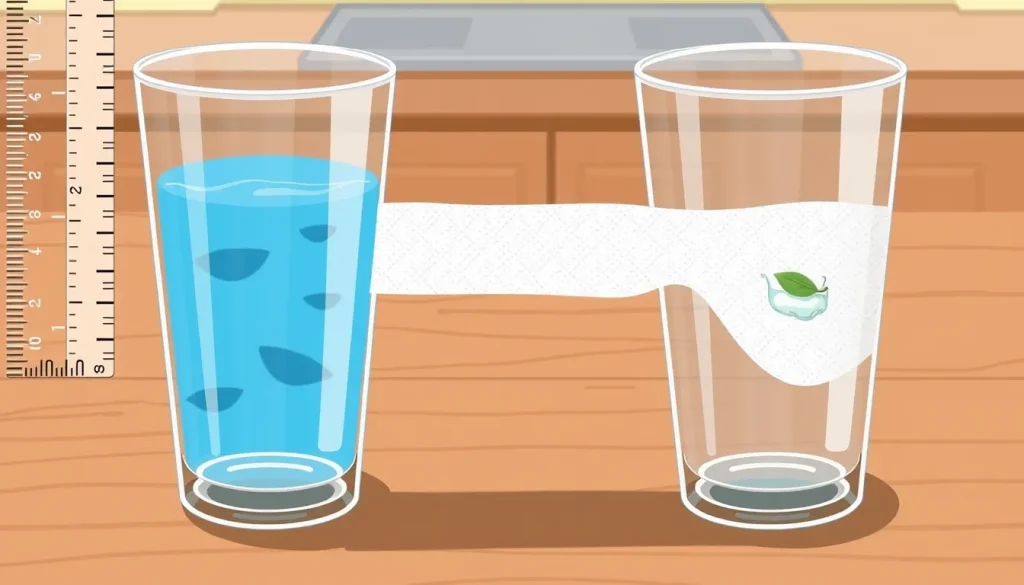
- Fill one cup (the “source” cup) about three‑quarters full with water. Add a few drops of food‑coloring if you want the water to be easier to see.
- Leave the second cup empty; this will be the “receiver” cup.
- Cut a strip of paper towel about 30 cm long and 2–3 cm wide.
- Place one end of the strip into the water so that it touches the bottom of the source cup. Let the other end hang over the edge of the empty cup, making sure the strip bridges the two cups without touching the bottom of the empty cup.
- Observe the water climbing up the paper towel and eventually dripping into the empty cup. This may take a few minutes.
- When the water has reached the empty cup (or after 10 minutes), gently lay a damp seed on the wet part of the paper towel that is inside the empty cup. If you are using a pre‑germinated seedling, place it so that the roots touch the wet towel.
- Cover the setup with a clear plastic bag or a dome to reduce evaporation and leave it undisturbed for at least 30 minutes.
- After the waiting period, check the seed. It should appear swollen, and if you used a dry seed, you may see the seed coat become translucent—a visual sign that the seed has taken up water.
What to observe
- How quickly the colored water climbs the paper towel (note the time it takes to reach the empty cup).
- The formation of droplets in the empty cup.
- Changes in the seed: swelling, color change, or visible root emergence after longer exposure.
- Any differences when using different types of paper towel or varying the length of the strip.
The science explained
Water molecules are attracted to each other (cohesion) and to the fibers of the paper towel (adhesion). In the tiny gaps between the fibers, adhesive forces pull water up the towel, while cohesion pulls the rest of the column behind it. This combination creates a “capillary rise” that can move water against gravity—the same principle that lets trees draw water from their roots to their highest leaves—as described in the capillary‑action activity from the University of Illinois [1].
Seeds absorb water through a process called imbibition. The seed coat is porous, allowing water to enter by capillary action. Once enough water is taken up, enzymes become active and the seed begins to sprout. The seed‑on‑a‑towel demonstration mirrors this natural uptake, giving a visual link between the paper‑towel wick and a real plant’s root system [2].
Model limitations
The paper towel acts as a simple, uniform capillary tube, whereas real plant roots contain complex tissues, active transport mechanisms, and pressure gradients that enhance water movement. Therefore, the demonstration shows the passive pull of water but does not capture the full biological processes that drive water uptake in seedlings.

Troubleshooting
- No water movement: Ensure the paper towel is fully in contact with the water and that the strip is not folded or blocked. The towel must be wet but not dripping.
- Water drips too quickly: Use a thicker towel or a shorter strip to reduce the capillary rise speed.
- Seed does not swell: Verify that the part of the towel touching the seed is actually wet. If the water stopped before reaching the seed, extend the strip or add more water to the source cup.
Next steps
- Measure the height of the water column at regular intervals and plot a simple graph of height vs. time.
- Compare different materials (e.g., coffee filter, fabric strip) to see which wicks water fastest.
- Extend the observation period to watch a seed germinate fully, recording root length each day.
- Introduce a control seed that is kept dry to highlight the effect of water uptake.
Related terms
- Capillary action
- The movement of liquid through narrow spaces without the assistance of external forces, caused by adhesion to the surface and cohesion within the liquid.
- Cohesion
- The attraction between like molecules—in this case, water molecules pulling each other together.
- Adhesion
- The attraction between water molecules and a different surface, such as the fibers of a paper towel.
- Imbibition
- The process by which dry seeds absorb water, swelling and activating metabolic processes that lead to germination.
Sources & references
- Capillary Action Activity – University of Illinois. https://www.igb.illinois.edu/sites/default/files/uploads/CapillaryActionActivity.pdf
- Seed Sprouting Experiment – National Air and Space Museum. https://airandspace.si.edu/learn/learning-resources/seed-sprouting-experiment
- Summer School with Live Science: Capillary action – Live Science. https://www.livescience.com/capillary-action-experiment-summer-school.html
- Escaping Water – Science World. https://www.scienceworld.ca/resource/escaping-water/