This demonstration lets children see how the energy of moving water can be turned into rotational motion. By building a small water wheel from everyday cardboard and running a stream of water over it, learners can measure the wheel’s speed and discuss the physics behind the motion.
Before you begin
- Choose a flat, level surface such as a kitchen table or a sturdy tray.
- Make sure the water source (a pitcher, jug, or a watering can) is within arm’s reach.
- Adult supervision is needed when cutting cardboard and handling scissors.
- Gather all materials before starting so the construction flow is uninterrupted.
Materials
- Corrugated cardboard or a clean pizza‑box (about 30 cm × 30 cm).
- Wooden skewer or a thin dowel (≈ 30 cm long) for the axle.
- Two short sections of drinking straw (or small cardboard tubes) to act as bearings.
- Scissors (child‑safe or adult‑only).
- Strong tape or glue.
- One small cup or bowl to hold water.
- A tray, shallow plastic container, or baking tray to catch overflow.
- Stopwatch or a phone timer.
All items are commonly found at home or in a classroom. If a straw is unavailable, a rolled‑up paper tube works equally well.
Build the water wheel
- Draw a circle about 12 cm in diameter on the cardboard and cut it out. This is the wheel hub.
- From the same sheet, cut 6–8 equal “paddles” – rectangles about 5 cm × 2 cm.
- Make a small hole in the centre of the hub and each paddle; thread the skewer through the hub, then attach the paddles evenly around the hub with tape, aligning the holes so they sit on the skewer.
- Secure the skewer ends in the two straw bearing sections. Tape the bearings to a small block of cardboard that will sit on the tray, forming a stable axle.
- Balance the wheel by turning it gently; adjust tape if any paddle drags.
These steps follow the simple construction described by Southfolk’s Water Wheel Power Test activity[1] and the Make‑A‑Water‑Wheel guide[2].
Set up the flow test
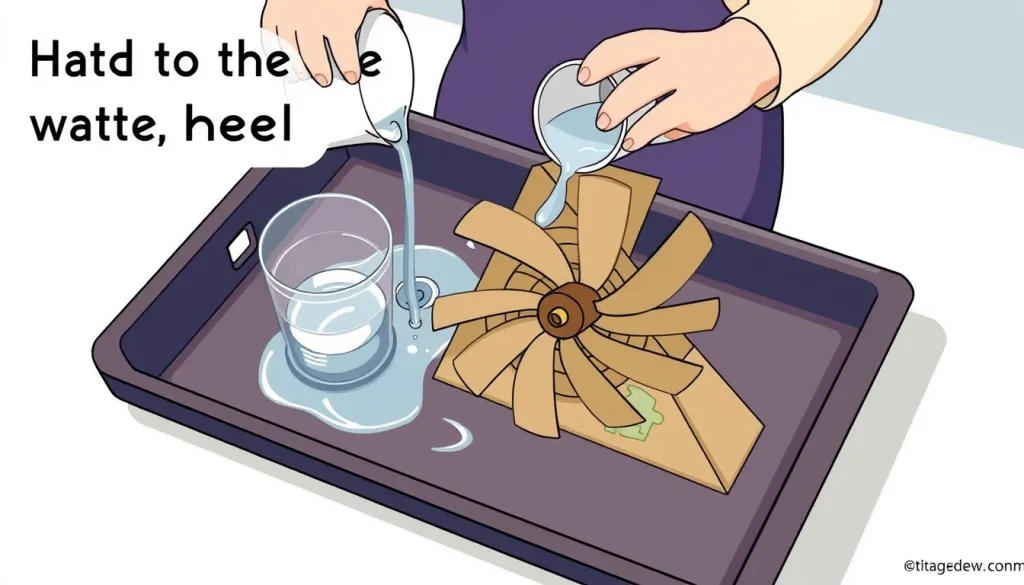
- Place the axle block in the centre of the tray so the wheel can spin freely.
- Fill the cup or bowl with water (about 200 mL).
- Hold the cup above the wheel and slowly pour a steady stream onto the paddles, aiming near the outer edge for maximum torque.
- Start the stopwatch as the water first contacts the paddles.
- Count how many full rotations the wheel makes in 10 seconds, then stop the water flow.
- Record the number of rotations; repeat the pour three times and average the result for a more reliable value.
What to observe and measure
- Rotational speed (RPM): Multiply the average rotations per 10 seconds by 6 to obtain revolutions per minute.
- Effect of water position: Notice if pouring closer to the rim makes the wheel spin faster than pouring near the centre.
- Stability: Watch for wobbling that indicates uneven paddle spacing.
The science explained
Water moving under gravity has kinetic energy. When this stream strikes the paddles, it exerts a force at a distance from the axle – a torque – that makes the wheel rotate. The torque (τ) equals the force (F) multiplied by the lever arm (r), the distance from the axle to the point where the water hits (τ = F · r). A larger lever arm (pouring onto the outer edge) produces more torque and a higher spin rate.
As the wheel turns, some of the water’s kinetic energy is transferred into rotational kinetic energy of the wheel (½ I ω², where I is the moment of inertia and ω is angular speed). Measuring the RPM gives a qualitative sense of how much power the water stream can deliver, because power is related to torque and angular speed (P = τ · ω).
This demonstration illustrates the principle behind historic water‑wheel mills that powered grain grinders and saws, and it connects directly to modern hydro‑electric concepts.
Troubleshooting
- Wheel does not turn: Check that the paddles are evenly spaced and not glued together. Make sure the axle rotates freely in the bearing straws.
- Wheel wobbles or falls off: Ensure the skewer is centered and the bearings are level. Add a small piece of cardboard under the axle to keep it stable.
- Water splashes out of the tray: Use a deeper tray or place a second shallow dish underneath to catch overflow.
- Inconsistent rotation counts: Use a steady hand when pouring, or set up a small funnel to deliver a constant stream.
Try another version
Once the basic wheel works, children can explore how design changes affect speed:
- Vary paddle size or shape (longer, wider, or angled).
- Increase the number of paddles (8 → 10) to catch more water.
- Raise the water source to increase the height‑and‑thus the speed‑of the stream.
- Replace cardboard with a lightweight plastic cup to reduce wheel mass.
Each modification offers a new observation that can be recorded using the same RPM method.
Cleanup and disposal
- Recycle the cardboard pieces after the activity.
- Wipe the tray and skewer dry; store the skewer for future projects.
- Dispose of any leftover water responsibly.
Next steps
Students can calculate an approximate power output by estimating the force of the water stream (mass × acceleration) and using the measured RPM. Comparing several wheel designs can lead to a simple engineering challenge: design the wheel that produces the highest power for a given water flow.
Related terms
- Water wheel
- A device that converts the energy of flowing water into rotational motion.
- Torque
- A twisting force that causes an object to rotate; calculated as force multiplied by the distance from the pivot point.
- Rotational speed (RPM)
- The number of full revolutions an object makes in one minute.
- Potential energy
- Stored energy due to an object’s position, such as water held at height before it falls.
Sources & references
- Water Wheel Power Test – Southfolk. https://southfolk.com.au/activity/water-wheel-power-test/
- Make A Water Wheel – Home Science Tools. https://learning-center.homesciencetools.com/article/how-to-make-a-water-wheel-science-project/
- STEM Water Wheel – Gratnells. https://www.gratnells.com/wimtarticle/stem-water-wheel
- Mini Water Wheel – out&about PDF. https://outdoorclassroomday.org.uk/wp-content/uploads/sites/2/2016/05/Chapter-5-Science-Mini-Water-Wheel.pdf